South Africa Tour of Zimbabwe 2026 T20 Pitch Reports, Full Squad
South Africa and Zimbabwe are set to clash twice in the space of four days as part of a landmark T20I tri-series in Windhoek, Namibia, with the two African heavyweights meeting on August 29 and September 1, 2026. While the fixtures often get billed simply as “South Africa vs Zimbabwe,” the bigger picture is more significant: this is not a bilateral tour but a historic three-team tournament also involving hosts Namibia, staged at the brand-new Namibia Cricket Ground (NCG) in Windhoek. The tri-series doubles as an early dress rehearsal for the 2027 ICC Men’s Cricket World Cup, which South Africa, Zimbabwe and Namibia will co-host.
For fans tracking the South Africa vs Zimbabwe fixtures specifically, here is everything you need to know — the full schedule, the story behind the tournament, a detailed pitch report for the Namibia Cricket Ground, likely squads for both sides, and the head-to-head record between two of Africa’s most storied cricketing rivals.
The Bigger Picture: A Tri-Series, Not a Bilateral Tour
Cricket Namibia, Cricket South Africa and Zimbabwe Cricket jointly confirmed the FNB T20 Tri-Series earlier this month, with the tournament running from August 28 to September 6, 2026. Rather than a straightforward two-team tour, the event brings all three nations together in a double round-robin format: each side faces the other two twice in the group stage, with the top two teams progressing to the final on September 6.
The tournament carries weight well beyond the trophy on offer. Cricket Namibia CEO Johan Muller described it as a reflection of the “strong partnership and shared vision to grow cricket across the African continent,” while Cricket South Africa CEO Pholetsi Moseki framed it as part of CSA’s commitment to strengthening the game in neighbouring countries while also building momentum ahead of next year’s World Cup, which South Africa, Zimbabwe and Namibia will co-host together. The tri-series is also being positioned as the foundation for a proposed Africa T20 Cup, an annual continental competition that organisers hope to launch from 2027 onwards, with proceeds from this tournament being channelled to the Africa Cricket Association to fund development programmes across the continent.
For South Africa, the trip to Windhoek also marks the unofficial start of their 2026-27 international season — a busy calendar that will later include series against Australia, Bangladesh and England. For Zimbabwe, it is a continuation of a hectic 2026 that has already featured white-ball cricket against Bangladesh and India. For Namibia, an ICC Associate Member, the series is a rare opportunity to test themselves against two full-member nations on home soil, and comes at a critical juncture as they continue their push for direct qualification to the 2027 World Cup through the ongoing League 2 cycle.
Full Tri-Series Schedule (All Matches at Namibia Cricket Ground, Windhoek)
- August 28 — Namibia vs South Africa
- August 29 — South Africa vs Zimbabwe
- August 31 — Zimbabwe vs Namibia
- September 1 — Zimbabwe vs South Africa
- September 3 — Namibia vs Zimbabwe
- September 4 — Namibia vs South Africa
- September 6 — Final (top two group-stage finishers)
The two headline South Africa-Zimbabwe fixtures fall on August 29 and September 1, four days apart, giving both sides a quick opportunity to respond to the result of the first meeting. Beyond the tri-series, South Africa will stay on in Windhoek for a three-match ODI series against Namibia from September 9 to 13 — the first-ever ODI meeting between the two nations, and an important step in Namibia’s build-up to the World Cup.
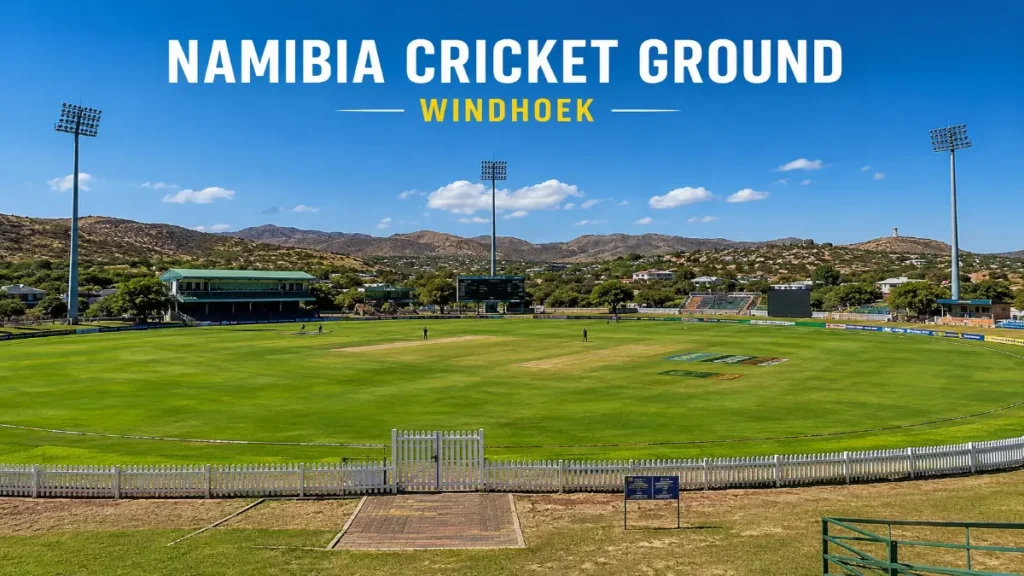
Namibia Cricket Ground: Pitch Report
All matches, including both South Africa-Zimbabwe fixtures, will be played at the Namibia Cricket Ground, a two-ground facility in Windhoek that opened in 2025 and is being developed with an eye firmly on hosting matches at the 2027 World Cup. Because the venue is still building an international match history, historical batting-versus-bowling trends are limited, but a few points are worth flagging for fans and fantasy players:
- Conditions: Windhoek sits at altitude on Namibia’s central plateau, and the thinner air typically helps the ball carry through to the wicketkeeper and travel further once it is middled — a factor that tends to favour stroke-play once batters get their eye in.
- Weather: Late August and early September fall in Namibia’s dry season, meaning rain interruptions are unlikely and matches should generally go the full 20 overs a side, with dew becoming a factor for evening fixtures as the tournament progresses.
- Surface behaviour: New venues in Southern Africa built to modern specifications tend to offer good pace and carry for seamers with the new ball, while turning true for spinners as the surface wears through a bilateral or tri-series window. Expect the tri-series’ early games to reward disciplined fast bowling up front, with totals likely climbing as teams and pitches settle in over the course of the tournament.
- Boundary dimensions: As with most purpose-built modern grounds, the square boundaries at the NCG are reported to be on the shorter side compared to straight ones, which typically benefits batters who can access the leg-side arc.
Teams batting first at a new venue with limited data available to them will lean heavily on training-session assessments and toss calls, making the toss an important early factor to track across the tournament.
South Africa Squad: A Development-Focused Group
South Africa will not have their full-strength side in Windhoek. With a packed home summer ahead featuring white-ball and Test cricket against Bangladesh and England, head coach Shukri Conrad and the national selectors are expected to rest several of the Proteas’ biggest names for the tri-series, mirroring the approach taken for South Africa’s T20I tour of New Zealand earlier in the year. That tour saw five uncapped players make their T20I debuts, with only Prenelan Subrayen among the group having previously represented the senior side in another format.
Reports around the squad selection suggest a similar template is likely for Namibia: a young, fringe-heavy group designed to build depth ahead of the next T20 World Cup cycle, captained in the probable absence of Aiden Markram by an experienced deputy such as Rassie van der Dussen, who has led similar development squads in the recent past. Players who featured for the SA A side on its tour of England in May — including left-arm pacer Kwena Maphaka, batter Jordan Hermann, all-rounder Nqobani Mokoena and seamer Nqaba Peter — are among those tipped to travel, giving South Africa’s next generation valuable game time against full-member opposition.
CSA’s broader strategy of contracting a pool of “Players of National Interest” outside the core national group has been designed precisely for tours like this one, allowing the senior side to be protected for the marquee assignments later in the year while still fielding a competitive unit in Windhoek. For a young South African squad, the tri-series offers a genuine opportunity to state a case for a place in the senior set-up, with selectors watching closely how the fringe players cope against the experienced core of Zimbabwe’s line-up.
Zimbabwe Squad: Raza’s Battle-Hardened Core
Zimbabwe travel to Namibia with a squad built around a settled core of white-ball performers who have featured heavily across the team’s packed 2026 calendar, which has already included series against Bangladesh and India. Sikandar Raza, Zimbabwe’s talismanic all-rounder, is expected to continue leading the side in the shortest format, as he has done consistently through recent series against India, Bangladesh and beyond.
The likely nucleus of the squad draws from names who have anchored Zimbabwe’s T20I set-up through the year: top-order batters Brian Bennett and Wessly Madhevere, wicketkeeper-batter Tadiwanashe Marumani, all-rounder Ryan Burl, and a seam attack fronted by Blessing Muzarabani and Richard Ngarava, with support expected from bowlers such as Newman Nyamhuri and Tanaka Chivanga. Bennett in particular has been a standout performer in recent tri-series cricket in the region, having top-scored in Zimbabwe’s most recent T20I series against Namibia.
Zimbabwe will see the tri-series as a chance to build further momentum on home continental soil after a mixed run of white-ball results through the year, and as a meaningful step in preparations for co-hosting the 2027 World Cup, for which Zimbabwe qualify automatically as a full member alongside South Africa.
South Africa vs Zimbabwe: Head-to-Head in T20Is
South Africa hold a commanding historical advantage over Zimbabwe in the T20I format, a reflection of the gulf in overall resources between the two boards even as Zimbabwe’s white-ball side has improved markedly in recent years, highlighted by their run to the Super Eight stage of the 2026 T20 World Cup. That said, Zimbabwe have shown they are capable of competitive, and occasionally victorious, performances against full-strength or near-full-strength Proteas sides on home soil, as seen during last year’s tri-series in Harare involving South Africa and New Zealand.
With South Africa expected to field a young, developing unit in Windhoek rather than their first-choice team, the gap between the sides on paper is likely to be narrower than the overall historical head-to-head suggests, adding an extra layer of intrigue to both the August 29 and September 1 fixtures.
Why This Series Matters
Beyond the results, the Windhoek tri-series is best understood as the first visible marker of the road to the 2027 World Cup on African soil — the tournament’s return to the continent after 24 years. With South Africa, Zimbabwe and Namibia all involved as co-hosts, matches like these double as venue-testing exercises for the region’s cricket boards and as opportunities to generate local excitement well ahead of the global event. For Namibia specifically, strong performances against two established Test-playing nations would be a significant boost to both team morale and their ongoing push for direct qualification into the 2027 World Cup through the League 2 structure, while the accompanying ODI series against South Africa — the first ODI meeting in the two nations’ history — adds further weight to a busy few weeks of cricket in the Namibian capital.
For South Africa and Zimbabwe fans specifically tuning in for the two head-to-head fixtures on August 29 and September 1, the series offers a first proper look at some of the next generation of Proteas talent, a chance to see Sikandar Raza’s settled Zimbabwe core in unfamiliar conditions, and an early glimpse of a venue that will be under the global spotlight when the World Cup arrives in October-November 2027.
Key Players to Watch
Sikandar Raza (Zimbabwe) — Still Zimbabwe’s most influential white-ball cricketer, Raza’s ability to shift momentum with bat or ball has made him the side’s automatic captaincy pick across the format for several years running. His head-to-head experience against South African bowling attacks, built up over multiple series, makes him the player most likely to trouble a young Proteas unit.
Brian Bennett (Zimbabwe) — Among the most exciting young batters to emerge from Zimbabwe’s system in recent seasons, Bennett has repeatedly delivered in tri-series cricket in the region and will be central to Zimbabwe’s top-order plans in Windhoek.
Blessing Muzarabani (Zimbabwe) — Zimbabwe’s spearhead with the new ball, Muzarabani’s height and ability to extract bounce could be a significant asset on a fresh Namibia Cricket Ground surface still finding its character.
Rassie van der Dussen (South Africa, if named captain) — Should he lead the side again in Markram’s likely absence, van der Dussen brings composure and know-how in blending youth with experience, a role he has filled for South Africa’s development squads on previous tours.
Kwena Maphaka (South Africa) — The left-arm quick has been fast-tracked through South Africa’s white-ball pathway and, if selected, offers genuine pace and variety with the new ball against a settled Zimbabwe top order.
Jordan Hermann and Nqobani Mokoena (South Africa) — Both featured for SA A on their tour of England earlier this year and represent the kind of fringe talent this tri-series is designed to expose to senior international cricket, with strong performances here likely to strengthen their case for future selection.
Broadcast and Streaming
Official broadcast and streaming details for the tri-series were still being finalised at the time of the schedule announcement. South Africa’s home broadcaster SuperSport has historically covered the Proteas’ white-ball tours in the region, while past Namibia-hosted series have also been streamed on platforms such as FanCode for international audiences. Fans are advised to check confirmations closer to the tournament, as coverage arrangements are typically announced by the host board in the days before the opening fixture.
Frequently Asked Questions
Is this a South Africa tour of Zimbabwe? No. Despite the two teams meeting twice, this is a three-team tri-series hosted by Namibia in Windhoek, also involving the Namibian national side. Zimbabwe are a visiting team at this event, just as South Africa are.
Where are the South Africa vs Zimbabwe matches being played? Both fixtures — August 29 and September 1 — will be played at the Namibia Cricket Ground in Windhoek, Namibia.
Will South Africa field their first-choice T20I side? Reports strongly suggest South Africa will send a development-focused squad, resting several senior players ahead of a packed home season against Australia, Bangladesh and England.
What happens after the tri-series? South Africa remain in Namibia for a historic three-match ODI series against the hosts from September 9 to 13 — the first-ever ODI meeting between the two nations.
Quick Reference
| Match | Date | Format | Venue |
|---|---|---|---|
| South Africa vs Zimbabwe | Aug 29, 2026 | T20I | Namibia Cricket Ground, Windhoek |
| Zimbabwe vs South Africa | Sep 1, 2026 | T20I | Namibia Cricket Ground, Windhoek |