ICC Cricket World Cup 2027 Matches: schedule, venues, teams, format and qualification explained: South Africa, Zimbabwe, Namibia host 14 teams in a new three-stage World Cup structure
Introduction
The ICC Men’s Cricket World Cup is set to make history in 2027 as the 50-over showpiece returns to African soil for the first time in 24 years. The 14th edition of the tournament will be jointly hosted by South Africa, Zimbabwe, and Namibia, marking a symbolic homecoming for a continent that last staged the event back in 2003, when South Africa, Zimbabwe, and Kenya shared hosting duties. This time around, Namibia joins the party as a co-host for the very first time, adding another milestone to a tournament that promises to be bigger, more competitive, and more far-reaching than any of its predecessors.
With a new three-nation partnership, an expanded 14-team field, and a revamped competition format, the 2027 World Cup is shaping up to be a transformative edition of one of cricket’s most prestigious events. Here is a comprehensive breakdown of everything currently known about the tournament — the hosts, the venues, the format, the qualification pathway, and what fans can expect when the action gets underway.
Three Nations, One Heartbeat
The tournament’s official brand identity, unveiled by the International Cricket Council, is “Three Nations, One Heartbeat” — a theme designed to celebrate the diversity, optimism, and sense of community shared by South Africa, Zimbabwe, and Namibia. The branding reflects more than just marketing; it signals a genuinely collaborative hosting arrangement between three nations with very different cricketing histories and infrastructure levels coming together for a single global event.
South Africa, as the most cricket-developed of the three hosts, will shoulder the lion’s share of hosting responsibilities. Reports indicate that the majority of matches — somewhere in the range of 40 or more of the tournament’s fixtures — will be played across South African venues, with Zimbabwe and Namibia contributing a smaller but historically significant number of games each.
For ICC Chairman Jay Shah, the announcement of the host cities and tournament brand represented a major milestone on the road to 2027. Shah has described the return of the tournament to Africa after 24 years as a landmark moment for the sport, one that is expected to unite fans across the continent and beyond while building anticipation for what is being billed as one of the biggest events in world cricket.
The Venues: Twelve Stadiums Across Three Countries
The ICC has confirmed a total of 12 host venues spread across the three co-host nations, unveiled during a ceremony held in Johannesburg.
South Africa (eight venues):
- Wanderers Stadium, Johannesburg
- SuperSport Park, Centurion (Tshwane)
- Newlands Cricket Ground, Cape Town
- Kingsmead Cricket Ground, Durban
- St George’s Park, Gqeberha
- Mangaung Oval, Bloemfontein
- Along with additional venues completing South Africa’s eight-city footprint
Zimbabwe (three venues):
- Harare Sports Club, Harare
- Queens Sports Club, Bulawayo
- Mosi-oa-Tunya International Cricket Stadium, Victoria Falls
Namibia (one venue):
- Namibia Cricket Ground, Windhoek
This distribution underlines South Africa’s role as the primary logistical hub of the tournament, while Zimbabwe’s inclusion of three venues, including the picturesque Victoria Falls stadium, offers a blend of established Test match history and scenic new-age cricket destinations. Namibia’s single venue in Windhoek represents a major coming-of-age moment for a nation that has steadily built its cricketing credentials through appearances in T20 World Cups and various ICC qualifying events, but has never before hosted matches at a Cricket World Cup.
Tournament Dates
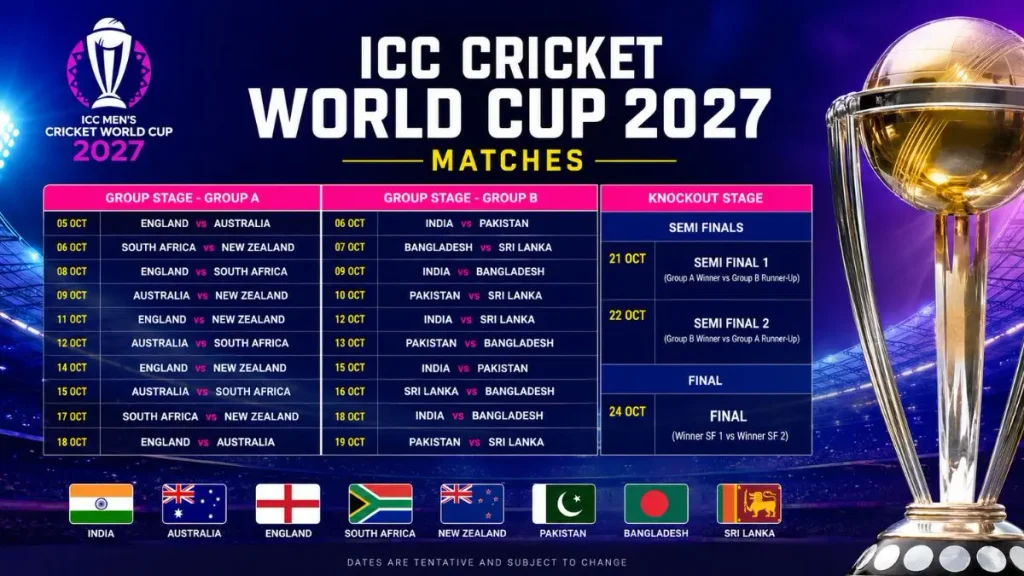
The ICC Men’s Cricket World Cup 2027 is provisionally scheduled to run from early October through late November 2027, with widely cited dates pointing to a start around October 4 and a conclusion around November 21, 2027. It’s worth noting that the ICC has not yet released the full match-by-match schedule with exact dates, venues, and timings for each fixture. That detailed schedule is expected to be published closer to the tournament, likely after the qualification process concludes in early 2027. Until then, fans and cricket boards alike are working off the provisional window while the ICC finalizes logistics.
A Bigger, Bolder Format
One of the most significant changes for 2027 is the expansion of the tournament field from 10 teams — the format used in both the 2019 and 2023 editions — to 14 teams. This is a return to the larger-scale format last seen in earlier editions of the World Cup and reflects the ICC’s broader push to grow the game’s global footprint by giving more nations a genuine pathway to cricket’s biggest stage.
Alongside the expanded field, the ICC has introduced a completely new three-stage format designed to inject additional context, competitiveness, and consequence into the tournament. Unlike the straightforward round-robin structure used in 2019 and 2023, the 2027 edition will unfold in three distinct phases:
Stage One — The Super Series: The three lowest-ranked qualifying teams among the 14 will play a round-robin format among themselves, known as the Super Series. Only the winning team from this opening stage progresses to the next round, effectively acting as a play-in phase for the tournament’s more marginal qualifiers.
Stage Two — The Group Stage: A total of 12 teams will feature in this round, comprising the 11 higher-ranked qualifiers plus the winner of the Super Series. These 12 sides will be divided into two groups of six, each playing a round-robin format totaling 30 matches. The top three teams from each group, along with the next-best-placed team across both groups (an extra “lucky loser” style qualifier), will advance to the next stage — meaning seven teams progress in total.
Stage Three — The Super 7: The seven teams who make it through the group stage will play one another once in a round-robin format, producing 21 matches. At the conclusion of the Super 7 phase, the top four teams on the points table will advance to the semi-finals. Notably, the seeding carries forward: the top-ranked team in the Super 7 will face the fourth-placed side in one semi-final, while the second and third-placed teams meet in the other — a system designed to reward consistent performance throughout the tournament rather than resetting entirely at the knockout stage.
The two semi-final winners will then meet in the grand final, bringing the tournament to its climax after roughly seven weeks of cricket.
In total, various reports have cited the tournament comprising either 54 or 57 matches depending on the source and whether preliminary play-in fixtures are counted, though the official structure outlined by the ICC — Super Series, Group Stage, and Super 7 — remains consistent across all reporting.
How Teams Qualify
The qualification pathway for the 2027 World Cup is more elaborate than in recent editions, reflecting both the expanded 14-team field and the ICC’s effort to make the qualifying process more meritocratic and inclusive of the sport’s growing base of nations.
Automatic hosts qualification: South Africa and Zimbabwe, as co-host Full Member nations, have already secured automatic qualification for the tournament. Namibia, despite co-hosting, does not receive an automatic berth, as it is not currently a Full ICC Member and must qualify through the standard pathway available to Associate nations.
Direct qualification via ODI rankings: The eight top-ranked teams in the ICC Men’s ODI Team Rankings, excluding the two host nations, will qualify directly for the tournament. The rankings snapshot used for this purpose will be taken at a confirmed cut-off point, with September 30, 2026, cited as a key reference date for determining several aspects of the qualification pathway, including which teams are eligible for various qualifying routes.
The CWC League 2 and Challenge League: Beneath the elite tier of automatically qualifying nations, a structured system of secondary competitions determines the rest of the field. The 2024–2026 Cricket World Cup League 2 features eight teams, with the top four progressing directly into the World Cup Qualifier. Meanwhile, a separate Challenge League — effectively cricket’s third tier of ODI competition — comprises 12 teams split into two pools of six, each contesting three round-robin tournaments across the qualification cycle. The top two sides from each pool advance to a Qualifier Play-off.
The Qualifier Play-off: This intermediate stage brings together the bottom four finishers from League 2 alongside the four teams progressing from the Challenge League. The top four finishers here earn a place in the final World Cup Qualifier tournament.
The World Cup Qualifier itself: The last stage of the pathway, the 2027 ICC Men’s Cricket World Cup Qualifier, will be a ten-team tournament running from February 22 to March 23, 2027. Its ten participants will include the two lowest-ranked Full Member nations in the ODI standings (excluding hosts South Africa and Zimbabwe) as of the September 30, 2026 cut-off, the top four sides from CWC League 2, and the top four from the Qualifier Play-off. Only the top four finishers from this ten-team Qualifier will punch their tickets to the World Cup itself, filling out the last of the 14 spots in the main tournament.
This layered system means that, in theory, any ICC member nation — from established Full Members to smaller Associate cricketing nations — has a mathematical pathway, however narrow, to reaching the 2027 World Cup, reinforcing the tournament’s growth ambitions.
Where Things Stand Right Now
As of now, several teams are strongly placed for direct qualification via the ODI rankings, though the picture remains fluid given that the qualification cut-off is still several months away. Traditional powerhouses of ODI cricket are expected to be in contention for top-eight rankings spots, but the margins are reportedly tight — with some reports suggesting the gap between the eighth-ranked side and teams just outside the automatic qualification zone is thin enough that results over the coming months could dramatically reshape the picture. Nations that have historically been consistent ODI performers will need to manage their bilateral fixture list carefully over the qualification window to safeguard, or improve, their standing.
Meanwhile, several Associate and lower-ranked Full Member nations are competing hard through the League 2, Challenge League, and Play-off structure for a shot at the ten-team Qualifier event in early 2027 — and, ultimately, a place among the 14 teams that will compete for the World Cup itself.
What Fans Can Expect
Beyond the on-field format and qualification intrigue, the 2027 World Cup carries broader significance for the growth of the game. Africa’s cricketing profile has grown steadily over the past decade, and hosting the sport’s biggest 50-over event across three nations — including a first-time host in Namibia — is expected to leave a lasting infrastructure and participation legacy in the region.
For broadcast audiences, particularly in cricket-mad markets like India, the tournament is expected to be available through major streaming and television partners, continuing the trend of wide digital and satellite coverage seen in recent ICC events. Exact broadcast details, as with the match schedule, are expected to be finalized closer to the tournament.
Conclusion
The ICC Men’s Cricket World Cup 2027 promises to be a landmark edition of the tournament — the first to be jointly hosted by three nations in this configuration, the first World Cup appearance for Namibia as a host, and the first return of the tournament to African soil in 24 years. With an expanded 14-team field, a fresh three-stage format built around the Super Series, Group Stage, and Super 7 phases, and a qualification pathway designed to reward performance across every tier of the game, the tournament represents a genuine evolution in how the ICC stages its flagship 50-over event.
While the ICC is yet to release the full match-by-match schedule, the broad picture is now clear: cricket’s biggest stars will descend on South Africa, Zimbabwe, and Namibia in October and November 2027 for a tournament that blends tradition with reinvention. As qualification battles intensify over the coming months and the World Cup Qualifier approaches in early 2027, anticipation will only continue to build for what is shaping up to be one of the most keenly anticipated editions of the Cricket World Cup in years.