England vs Sri Lanka Pitch Reports, Full Squads, 2026: Everything You Need to Know
Sri Lanka are set to return to England in September 2026 for a white-ball-only tour that will see the two sides clash in three T20Is and three ODIs across six of the country’s most iconic cricket grounds. With the tour scheduled at the back end of the English summer, both teams will be using the series to fine-tune their combinations ahead of the 2027 ICC white-ball tournaments. Here is a complete breakdown of the fixtures, venue-by-venue pitch reports, and the squads expected to take the field.
England vs Sri Lanka 2026: Full Schedule (IST)
The tour runs for a fortnight, opening with the T20I leg before moving into the 50-over matches. All timings below are in Indian Standard Time (IST), which is 4 hours 30 minutes ahead of British Summer Time (BST).
| Match | Date | Venue | Time (IST) |
|---|---|---|---|
| 1st T20I | 15 September 2026 | Utilita Bowl, Southampton | 11:00 PM |
| 2nd T20I | 17 September 2026 | Sophia Gardens, Cardiff | 11:00 PM |
| 3rd T20I | 19 September 2026 | Old Trafford, Manchester | 11:00 PM |
| 1st ODI | 22 September 2026 | Banks Homes Riverside, Durham (Chester-le-Street) | 5:00 PM |
| 2nd ODI | 24 September 2026 | Headingley, Leeds | 5:00 PM |
| 3rd ODI | 27 September 2026 | The Kia Oval, London | 3:00 PM |
Because all three T20Is are day-night affairs starting at 6:30 PM local time, Indian fans will need to tune in late at night, while the ODIs — two of them floodlit and the series finale a day match — kick off in the early-to-late evening IST window, making them far more convenient viewing for the subcontinent audience.
The series marks the third phase of a busy year for both nations. Sri Lanka toured England for a white-ball series that was formally confirmed back in mid-2025, with the tour forming part of the ECB’s 2026 home international summer alongside visits from India, New Zealand and Pakistan. For Sri Lanka, this trip comes on the back of a home white-ball series against England earlier in the year and gives them a rare look at English conditions in early autumn, when the pitches and outfields play quite differently from the height of summer.
Venue-by-Venue Pitch Report
Utilita Bowl, Southampton — 1st T20I
The Ageas Bowl, now known as the Utilita Bowl, is traditionally a batting-friendly surface with true bounce and minimal lateral movement once the new-ball shine wears off. Under lights in mid-September, however, dew and cooler evening air tend to help the ball skid on, and fast bowlers who hit hard lengths — the kind England’s attack specialises in — can extract good carry through to the keeper. Boundaries are on the shorter side square of the wicket, so expect plenty of pulls and cuts. Teams winning the toss here have historically preferred to bowl first under lights.
Sophia Gardens, Cardiff — 2nd T20I
Cardiff’s surface is known for being a touch slower than Southampton’s, offering some grip to spinners as the game wears on. The ground’s compact dimensions still favour batters overall, but seamers who can change pace effectively tend to trouble batters in the middle overs. With a day-night start, dew is again likely to be a factor in the second half of the innings, generally nudging captains towards chasing.
Old Trafford, Manchester — 3rd T20I
Old Trafford in late September can be unpredictable, with cooler temperatures and occasional overcast conditions giving early assistance to seam and swing bowlers. Once the ball gets older, the pitch tends to flatten out and support strokeplay, particularly straight down the ground given the relatively larger boundaries at this end of the trip. This venue has often produced tight, low-scoring T20 contests compared to the flatter tracks used earlier in the series.
Banks Homes Riverside, Chester-le-Street (Durham) — 1st ODI
Durham’s Riverside ground is renowned as one of England’s more bowler-friendly venues, especially with the new ball. The surface typically offers consistent seam movement and can even encourage some sideways deviation off the surface, which is why sides batting first here often set moderate rather than mammoth totals. As the innings progresses and the pitch dries out, it becomes easier to bat on, but the opening 10-15 overs are usually the toughest passage for batters all series.
Headingley, Leeds — 2nd ODI
Headingley is famous for its capricious weather and a pitch that historically rewards bowlers who bowl full and straight, using the slope to generate movement both ways. Overhead conditions play a big role here — under grey skies, the ball swings appreciably, while on brighter days the surface flattens into a genuine 300-plus batting deck. September fixtures at Headingley have often thrown up exciting, fluctuating contests rather than one-sided run-fests.
The Kia Oval, London — 3rd ODI
The Oval typically offers one of the best batting surfaces in the country, with even bounce, a hard outfield and boundaries that reward clean hitting. It is also a venue where spinners can find turn in the back half of a match, particularly on a used late-September pitch. Given the series finale is a day match rather than day-night, batting first and posting a big total has historically been the more successful strategy here.
England vs Sri Lanka Pitch Reports, Full Squad, 2026
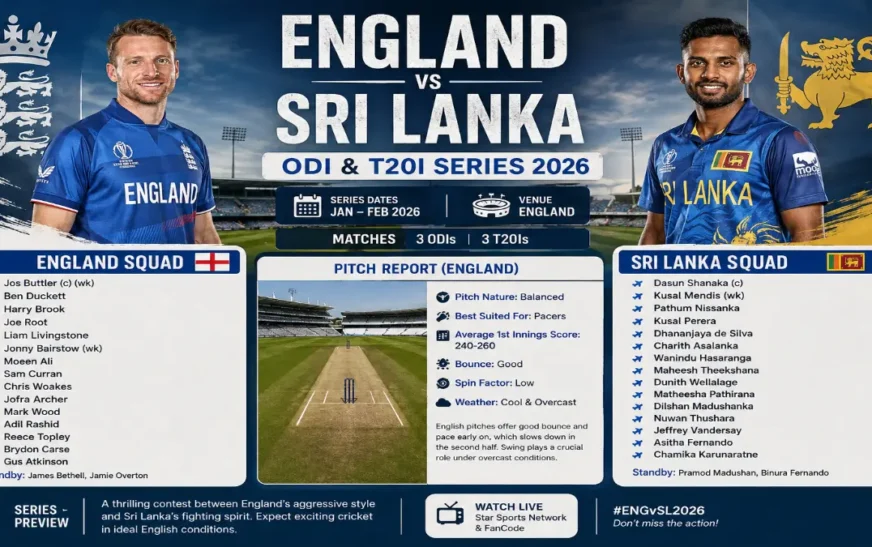
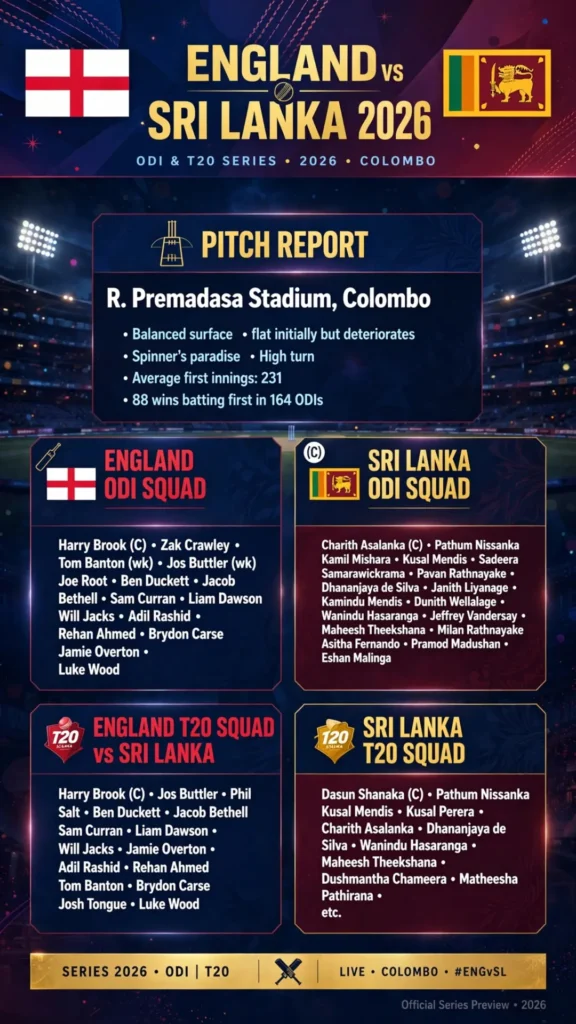
England’s white-ball unit for the Sri Lanka assignment is expected to be built around the core group that has represented the side through the 2026 season, including the T20 World Cup earlier in the year. Harry Brook continues to lead the side across both white-ball formats, with the panel likely to blend proven performers with some fringe players looking to nail down their places ahead of the 2027 ICC events.
Likely core group (T20I/ODI):
- Harry Brook (Captain)
- Jos Buttler (wicketkeeper)
- Phil Salt
- Ben Duckett
- Will Jacks
- Jacob Bethell
- Tom Banton
- Sam Curran
- Liam Dawson
- Jamie Overton
- Adil Rashid
- Rehan Ahmed
- Brydon Carse
- Josh Tongue
- Luke Wood
- Jofra Archer (fitness permitting)
- Joe Root and Zak Crawley have both featured in England’s 50-over set-up during 2026 and could be included specifically for the ODI leg to add batting depth in the middle order.
England’s think tank has shown a clear pattern this year of resting or rotating certain fast bowlers between formats, so expect at least a couple of changes in personnel between the T20I and ODI squads, particularly among the seam-bowling group. Ben Stokes remains focused on the Test side and is not expected to be involved in this white-ball leg.
Sri Lanka Squad: Likely Line-up
Sri Lanka’s white-ball setup has stayed fairly settled through 2026, built around a core of experienced campaigners alongside a clutch of exciting young talents who have impressed through the year. Dasun Shanaka has continued to captain the side through recent white-ball assignments and is expected to lead the touring party, though selectors could also look to give more responsibility to some of the newer faces given this tour’s role in the broader 2027 World Cup build-up.
Likely core group (T20I/ODI):
- Dasun Shanaka (Captain)
- Pathum Nissanka
- Kusal Mendis (wicketkeeper)
- Kamil Mishara
- Kusal Janith Perera
- Dhananjaya de Silva
- Charith Asalanka
- Janith Liyanage
- Wanindu Hasaranga
- Dunith Wellalage
- Maheesh Theekshana
- Matheesha Pathirana
- Dushmantha Chameera
- Pramod Madushan
- Pavan Rathnayake
- Angelo Mathews could feature in the ODI leg specifically, given his continued value in the 50-over format even as his T20I involvement has reduced.
Sri Lanka’s think tank is likely to lean on the same top-order pairing of Nissanka and Mishara that has anchored their batting through much of the year, while their bowling attack’s biggest strength remains its variety of pace options — from the raw speed of Pathirana to the more traditional seam of Chameera and Madushan — backed by the wrist-spin of Hasaranga and the all-round utility of Wellalage and Theekshana.
Note: Official touring squads for this series are typically confirmed by both boards roughly two to three weeks before the first match. The names above reflect the core group both sides have used consistently through the 2026 season and should be treated as the most likely composition until the formal squad announcements are made.
Key Head-to-Head Storylines to Watch
England have generally held the edge over Sri Lanka in bilateral white-ball cricket on home soil in recent years, with their power-hitting depth and pace-heavy attack tending to suit English conditions better than most visiting sides. Sri Lanka, though, have shown they are capable of pulling off upsets when their spin-and-pace combination clicks, and this series — coming right at the end of the English season when pitches offer a little more for the bowlers than in high summer — could be tighter than the recent head-to-head record suggests.
A few individual match-ups are worth tracking through the series:
- Jos Buttler and Phil Salt against Sri Lanka’s new-ball pace pair in the powerplay overs will likely dictate how quickly England can get away in the T20Is.
- Wanindu Hasaranga’s wrist-spin against England’s middle order — historically one of Sri Lanka’s most potent weapons in tight contests.
- Matheesha Pathirana’s slingy pace at the death in swing-friendly conditions at grounds like Old Trafford and Headingley.
- England’s seam battery (Archer, Carse, Overton, Tongue) exploiting the new Dukes ball in the early overs of the ODIs, especially at Durham where lateral movement is a near guarantee.
Weather and Toss Trends to Keep in Mind
Late September in England sits right at the edge of the white-ball season, and conditions can swing quite a bit from fixture to fixture. Southampton and Cardiff, being coastal or near-coastal venues, tend to hold on to some late-summer warmth and are less prone to rain interruptions than the northern venues. Manchester and Leeds, by contrast, are notorious for unpredictable weather even in peak summer, so both the Old Trafford T20I and the Headingley ODI carry a genuine risk of overs being lost to rain or a delayed start. Durham, being England’s northernmost international venue, is usually the coolest of the six grounds on this tour, which historically has meant more assistance for the new ball and lower first-innings totals compared to venues further south.
Toss decisions across the tour are likely to follow a fairly predictable pattern. In the day-night T20Is, dew is expected to become a factor after sundown at all three venues, which typically encourages captains to bowl first and chase. In the ODIs, the pattern flips somewhat — at Durham and Headingley, teams winning the toss have often chosen to bowl first to exploit early seam movement, while at The Oval, historically one of the better batting tracks in the country, batting first and setting a target remains the more common and successful approach.
Frequently Asked Questions
Where can Indian fans watch the England vs Sri Lanka 2026 series? Broadcast and streaming details are typically confirmed by the host broadcaster closer to the series, but past England–Sri Lanka bilateral tours have been telecast in India on Sony Sports Network with streaming available on the Sony LIV app.
How many matches are there in total? Six matches in total — three T20Is followed by three ODIs — played across six different English venues over a 12-day window from 15 to 27 September 2026.
Which venue is hosting the most matches? Each of the six venues hosts exactly one match on this tour, giving fans across England a chance to see the Sri Lankan side up close without any ground repeating a fixture.
Is this series part of any ICC points table? Because the tour consists solely of white-ball cricket rather than Tests, it does not carry World Test Championship points, but strong performances here will still count heavily toward both sides’ preparation and squad-planning for the 2027 ICC white-ball tournaments.
Why This Series Matters
With no Test cricket on the itinerary, both boards are using this tour purely as a white-ball proving ground. For England, it’s a chance to keep experimenting with squad depth beyond the core group that has carried them through 2026, while for Sri Lanka it’s valuable exposure to English conditions in the shoulder season between summer and autumn — conditions that could closely mirror what teams face during ICC events hosted in similar climates. Fans in India, given the late-night T20I slots and more convenient ODI timings, will have plenty of opportunity to catch the action live as the series builds toward its climax at The Oval in late September.