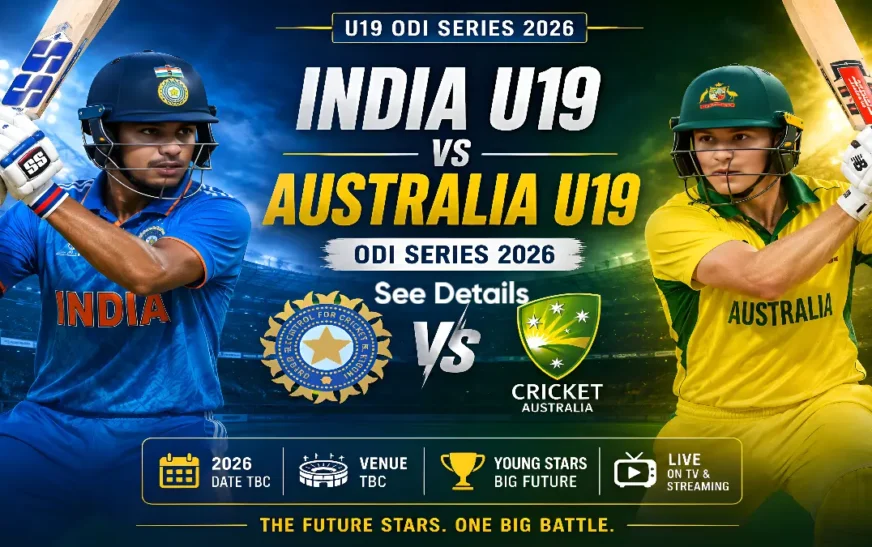
India u19 vs Australia u19 ODI 2026 Schedule: Full Fixtures, Timings, Venue and Series Preview
Indian domestic and youth cricket calendars are set for an exciting phase in September 2026, as the India Under-19 team gears up to host Australia Under-19 for a three-match Youth ODI series. This series marks the opening leg of a much bigger multi-format tour that will also see the two age-group sides clash in a pair of Youth Test matches later in the same window. For fans who track India’s cricketing pipeline closely — the pool from which future India senior team stars are drawn — this series is one of the most anticipated fixtures of the season.
Below is a complete breakdown of the India U19 vs Australia U19 ODI 2026 schedule, match timings, venue details, and everything else you need to know about this high-profile youth series.
India u19 vs Australia u19 ODI 2026 Schedule
All three Youth ODIs in this series will be played at a single venue — Rajkot — over a six-day window in September 2026. Here is the complete match-by-match schedule:
| Match | Date | ||||
|---|---|---|---|---|---|
| 1st Youth ODI | September 18, 2026 | ||||
| 2nd Youth ODI | September 21, 2026 | ||||
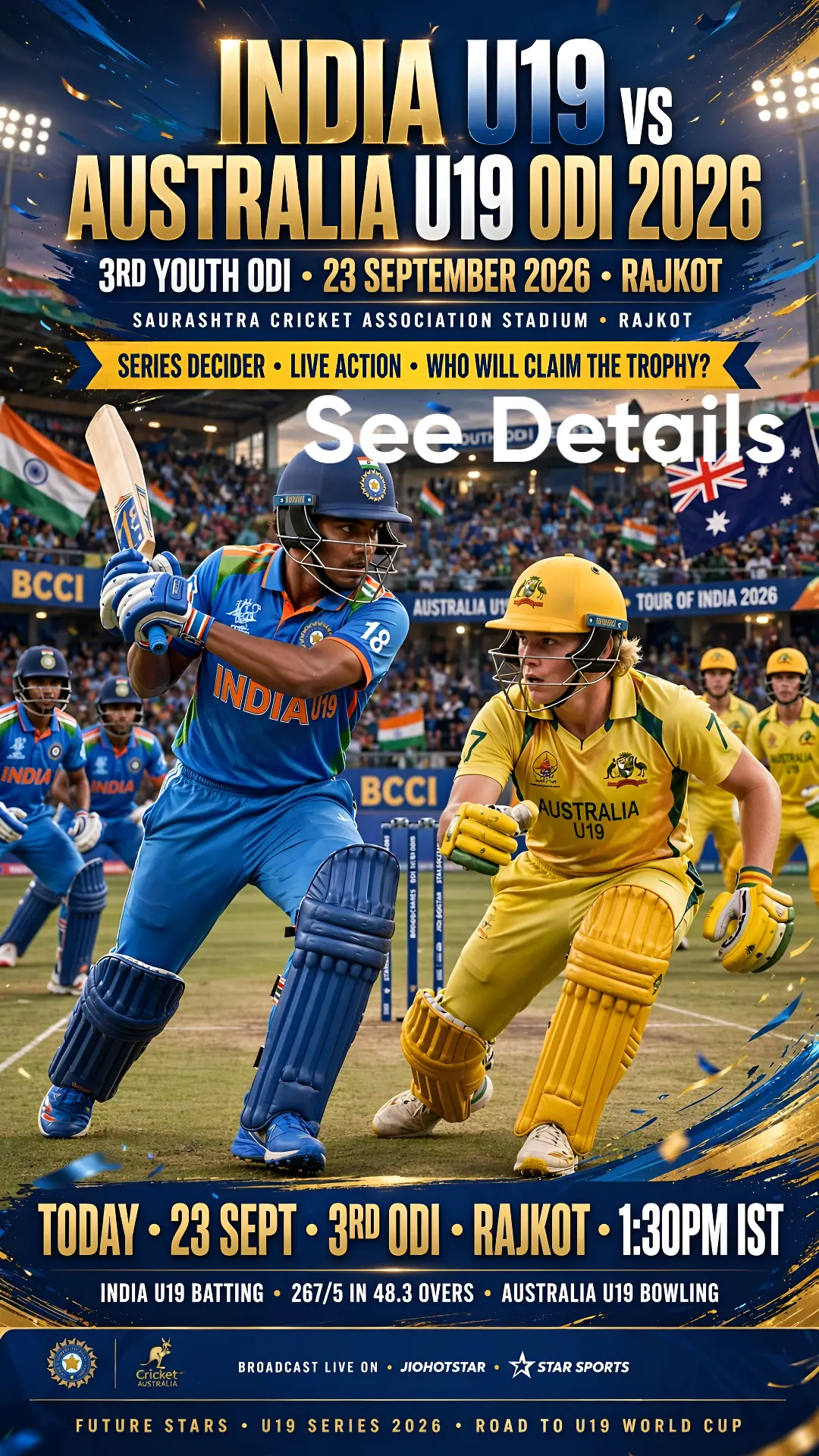
| 3rd Youth ODI | September 23, 2026 |
All three matches will begin at the same time slot — 9:00 AM local time in India, which translates to 3:30 AM GMT — allowing fans across different time zones to plan their viewing schedule with ease. As of now, all three fixtures are yet to begin, and match previews, team news, and toss updates will be updated closer to each game.

Series and Venue Details
Series: Australia Under-19s tour of India, 2026
Format: Youth One Day Internationals (50-over format)
Number of matches: 3
Venue: Rajkot (all three ODIs)
Match timings: 9:00 AM Local | 3:30 AM GMT (all matches)
Series result status: Match yet to begin (as of publication)
Interestingly, the three-match Youth ODI series will be played in Rajkot between September 18 and 23, four days before India A and Australia A begin their own multi-day series, making this a busy and significant period for Indo-Australian cricketing ties at both the A-team and age-group levels.
Beyond the ODIs: What Comes Next in the Tour
The three Youth ODIs are only the first phase of a longer engagement between the two junior sides. Once the one-day series concludes on September 23, the two teams will not go their separate ways immediately. The same venue, Rajkot, will also host the first Youth Test match starting September 27, running through September 30. Following that, the two sides will shift base to the Ahmedabad B Ground for the second and final Youth Test, which begins on October 5 and runs through October 8.
This means the full India U19 vs Australia U19 tour of 2026 essentially unfolds in two parts:
White-ball leg: Three Youth ODIs in Rajkot (September 18–23)
Red-ball leg: Two Youth Tests — first in Rajkot (September 27–30) and second in Ahmedabad (October 5–8)
This structure gives selectors and coaching staff on both sides a genuine opportunity to evaluate their young cricketers across formats, which is particularly valuable at the Under-19 level, where many players are still adapting their games to longer, more demanding conditions.
It’s also worth noting that this Australia Under-19 tour is not happening in isolation. Australia A men are touring India in the same broader window for a multi-format series against India A, featuring unofficial Test matches and unofficial ODIs in Puducherry, while Australia A women are also set to tour India around the same period. September and October 2026 are shaping up to be a genuinely packed cross-format calendar for Indo-Australian cricket relations across multiple levels — from the senior women’s game to A-team cricket to the Under-19 pipeline.
Context: India Under-19’s Recent Form
India’s Under-19 side arrives into this series on the back of a hugely successful run. The junior Indian team was recently crowned champions at the Under-19 World Cup, with a standout, record-breaking innings from a young batter who was the youngest player at that tournament propelling India to their sixth Under-19 world title. That kind of tournament-winning pedigree naturally raises expectations heading into any bilateral series, and the Rajkot ODIs will be an early test of whether that World Cup form can be sustained in a bilateral, non-tournament context against quality opposition.
Before this home series against Australia, India U19 were also on the road, playing a tour of Sri Lanka featuring both ODIs and Youth Tests. That tour included a three-match ODI series in Hambantota in July 2026, followed by two Youth Test matches, including the second Test in Colombo from July 20 to 23. Squad continuity between that Sri Lanka assignment and this home series against Australia will be an interesting subplot — several players who impressed on that tour are likely to carry that momentum into the Rajkot fixtures.
One name that has generated genuine buzz around this era of Indian youth cricket is that of a player with strong cricketing bloodlines. A son of a former India captain was named in the India Under-19 squad for the ODI leg of the Sri Lanka tour earlier in 2026, continuing a long tradition of family legacies feeding into India’s cricketing production line. Whether that player features in the squad for the Australia series will be closely watched by fans and scouts alike.
The Rajkot Factor
Rajkot’s Saurashtra Cricket Association Stadium has built a strong reputation over the years as one of India’s more balanced pitches — generally good for batting early on, but offering enough assistance to spinners as a match wears on. This makes it a fitting venue for a series where both teams will be eager to test their batters against turning tracks and their spinners against inexperienced touring batting line-ups. The ground has previously played host to memorable senior India-Australia contests, including a decisive one-day international where India sealed a series with a comfortable margin in front of a boisterous home crowd. Hosting three consecutive age-group ODIs at the same venue also means that any advantage gained by reading the surface correctly in the first match could carry over into the following two games, making the series more of a tactical chess match than a set of standalone contests.
For the broadcasters and organisers, using a single venue for the entire ODI leg also simplifies logistics considerably, allowing both squads to settle into a rhythm without the disruption of travel between fixtures — something that can matter a great deal for younger players still adjusting to the demands of a long, multi-format tour.
Squad Considerations and Selection Battles
While full squads for the ODI series are expected to be announced closer to the opening fixture, both boards are likely to lean on a blend of continuity and fresh faces. For India, several members of the victorious Under-19 World Cup squad, along with players who featured on the recent tour of Sri Lanka, are strong contenders to retain their places. Selectors will also be keeping half an eye on the upcoming Youth Test matches later in the tour, meaning the ODI series could double as an audition for red-ball spots as well.
On the Australian side, this tour represents an important opportunity for their age-group cricketers to gain first-hand experience of Indian conditions ahead of what is likely to be a long-term development pathway toward senior international cricket. Historically, touring Australian junior sides have found the transition to slow, turning subcontinental pitches challenging, and how quickly this current group adapts could be a useful indicator of their readiness for senior tours down the line.
Why This Series Matters
For casual fans, an Under-19 bilateral series between India and Australia might seem like a relatively low-key fixture compared to senior international cricket. But for those who follow the sport closely — particularly talent scouts, franchise recruitment teams, and hardcore domestic cricket enthusiasts — these matches carry real significance for several reasons:
1. A proving ground for future stars Almost every recent India men’s team regular — from top-order batters to strike bowlers — passed through the Under-19 pipeline at some stage. Performances in bilateral series like this one, away from the glare of a World Cup, often tell selectors more about a player’s consistency and temperament than a single knockout tournament innings.
2. India vs Australia rivalry starts early The India-Australia cricketing rivalry is one of the most storied in the modern game at the senior level, and that intensity increasingly starts at the age-group level too. Players who face off in Under-19 cricket today are frequently the same names competing in Test matches, ODIs, and T20Is against each other a few years down the line. Watching this series offers an early glimpse of the next generation of that rivalry.
3. Home conditions advantage for India With all three ODIs and the first Youth Test being played in Rajkot, India’s junior side gets the benefit of familiar conditions and, presumably, a supportive home crowd. Saurashtra’s cricketing infrastructure has hosted senior India-Australia fixtures in the past, and Rajkot in particular has a strong pedigree as an ODI venue, having previously hosted a decisive fixture in a senior India-Australia bilateral series.
4. Format versatility on display With both white-ball and red-ball cricket packed into a single tour, coaches on both sides get a genuine multi-format assessment of their young talent pool — useful not just for these specific matches, but for broader squad planning heading into future age-group tournaments.
What to Expect From the Contests
Given that both India and Australia have well-regarded age-group development systems, expect competitive, high-intensity cricket despite the “youth” tag. Indian conditions in September — with typically dry, slow, and turning pitches as the monsoon recedes — are likely to test Australian batters unfamiliar with subcontinental spin, while Indian batters will look to build on the momentum of their World Cup triumph against a disciplined Australian bowling attack known for producing skilful, well-drilled young pace bowlers.
Toss decisions, the composition of both playing XIs, and early powerplay approaches in the first ODI on September 18 will likely set the tone for the rest of the series. Since all three matches are being played at the same venue, teams that adapt fastest to Rajkot’s surface and outfield conditions could gain a psychological and tactical edge as the series progresses.
How to Follow the Series
As these are age-group fixtures, live broadcast details, streaming platforms, and ball-by-ball commentary access can vary and are usually confirmed closer to the tour dates by the respective cricket boards. Fans are advised to check official BCCI and Cricket Australia channels, along with major cricket score-tracking platforms, for live scores, squad announcements, and streaming information as the series approaches.
With India’s Under-19 side riding high on their recent world title and Australia looking to test their young talent in tough Indian conditions, this three-match ODI series promises to be an entertaining curtain-raiser to a bigger multi-format tour. Cricket fans, especially those tracking the next generation of India-Australia stars, will want to keep this schedule bookmarked as September 2026 approaches.