Cricket Pitch Length At the heart of every cricket match is a 22-yard strip that impacts outcomes more than any player. As the provided document notes, “A cricket pitch is the 22-yard rectangular strip at the center of the field that directly dictates the outcome of any cricket match.” This corridor of soil, grass, and moisture can turn a contest into a batsman’s paradise or a bowler’s nightmare.
Understanding the cricket pitch goes beyond its length. It requires grasping engineering standards, soil composition, the visual cues of cracks and grass, and how pitch quality is evaluated. This article examines key points from the source: ICC-mandated dimensions, pitch types, soil science, and the art of reading pitch reports.
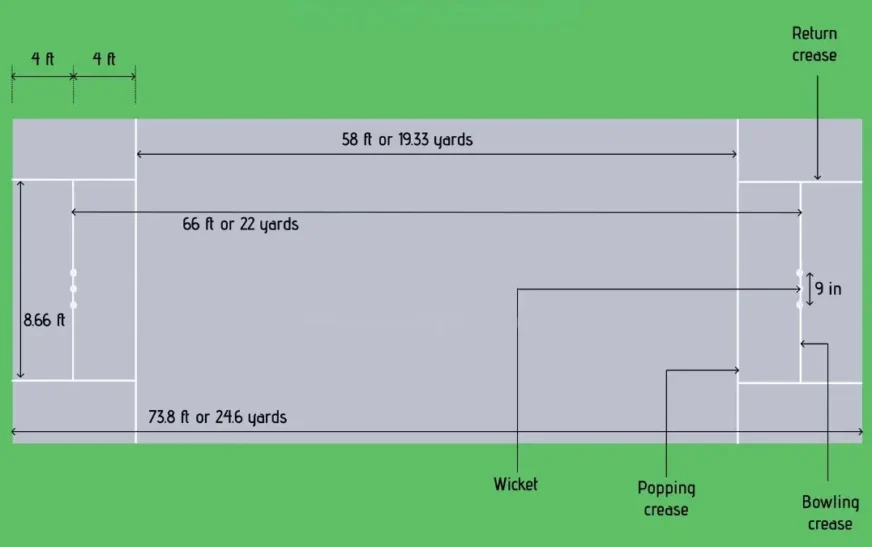
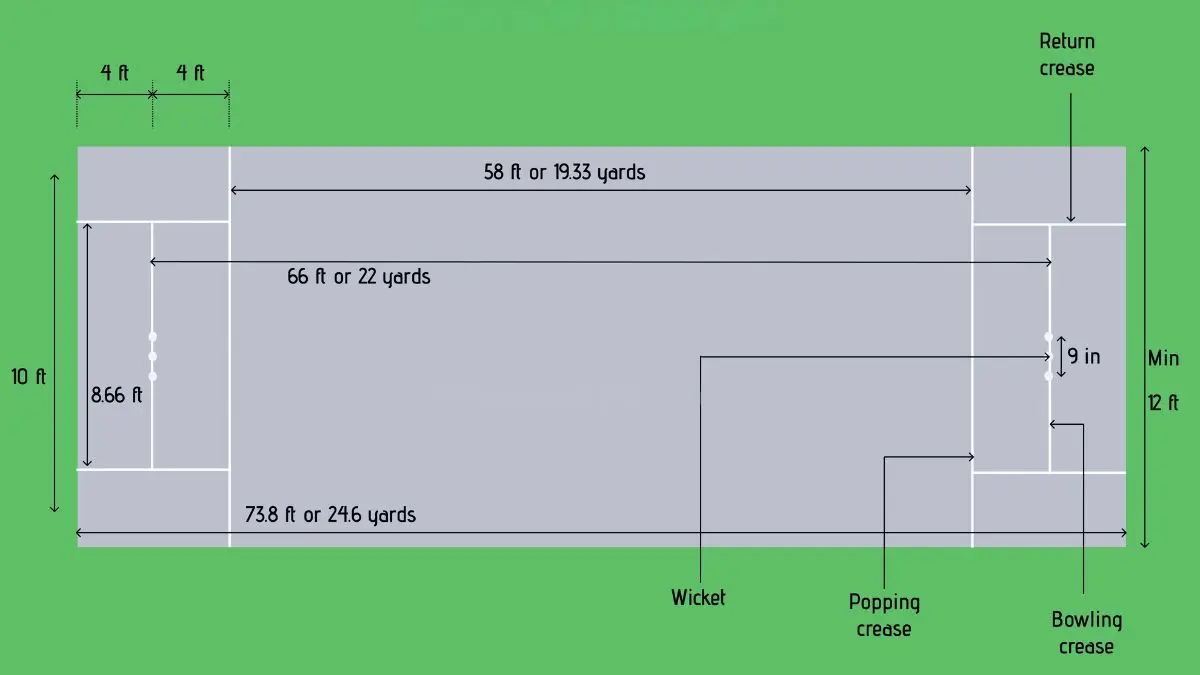
Feature | Measurement | Metric Measurement |
Total Length (Stump to Stump) | 22 Yards (66 feet) | 20.12 Metres |
Total Width | 10 Feet | 3.05 Metres |
Popping Crease (Batting Crease) | 4 Feet from stumps | 1.22 Metres |
Bowling Crease Width | 8 Feet 8 Inches | 2.64 Metres |
Stump Height | 28 Inches | 71.12 Centimetres |
Standard Dimensions & Crease Markings – The Law of the Land
The International Cricket Council (ICC) does not leave the pitch’s design to chance. According to the provided text, the ICC “enforces strict, non-negotiable legal measurements for the core playing strip.” These dimensions are the foundation upon which all other aspects of the game are built. Any deviation, at any level of professional cricket, would fundamentally alter the sport’s balance.
The total length of the pitch, measured from stump to stump, is exactly 22 yards, which converts to 66 feet or 20.12 meters. This distance is the very definition of the bowler’s challenge and the batsman’s reaction time. It is the same in Mumbai as it is in Melbourne. The total width of the playing strip is 10 feet, or 3.05 meters, providing a narrow enough target to encourage attacking bowling while offering just enough width for defensive strokes.
Beyond the overall length and width, the crease markings create the legal boundaries for batting and bowling. The popping crease—often referred to as the batting crease—is positioned 4 feet (1.22 meters) in front of the stumps. This line dictates whether a batsman is in or out of their ground and establishes the point at which a bowler must deliver the ball. The bowling crease, which runs parallel to the stumps, has a width of 8 feet 8 inches, or 2.64 meters. This is the line the bowler must not overstep, and its generous width allows for varied angles of attack.
Finally, the visual targets of the game—the stumps—have a mandated height of 28 inches, equivalent to 71.12 centimeters. Together, these measurements create a standardized arena of combat. Without these non-negotiable figures, the statistics of runs, wickets, and averages would be meaningless. The pitch, in its physical dimensions, is the first and most immutable law of cricket.
The Core Types of Cricket Pitches – Five Faces of the Turf
While dimensions remain constant, the behavior of a pitch is anything but. As the document notes, citing TS MISHRA University (via Merriam-Webster’s definitional context), “The nature of the soil, moisture levels, and grass density alter how a ball behaves when it hits the turf.” The provided material outlines five distinct types of pitches, each producing a unique brand of cricket.
1. Green Pitch
A green pitch is exactly what it sounds like: “Covered with a live, visible layer of grass.” This is not merely aesthetic. The live grass retains moisture within the surface, which prevents the pitch from drying out and hardening quickly. For a fast bowler, a green pitch is a weapon of promise. The presence of grass allows the new ball to grip the surface, generating seam movement off the pitch, while the underlying moisture assists swing movement through the air. Batters face a difficult early session where the ball can deviate off the straight line unpredictably. The green pitch favors the bowling side, particularly in the first innings of a match.
2. Flat Track / Dead Pitch
At the opposite end of the spectrum lies the flat track, also called a dead pitch. The document describes this surface as “rolled heavily to remove all moisture and grass.” The result is a hard, even, and unresponsive surface. Because there is no grass to cause deviation and no moisture to encourage swing, the ball offers “true, predictable bounce with zero lateral movement.” For a batsman, this is paradise. The lack of unexpected movement allows them to play strokes freely, trust the bounce, and score heavily. For bowlers, especially fast bowlers, the flat track offers little assistance, turning matches into high-scoring marathons.
3. Dusty Pitch / Dust Bowl
In contrast to the hard flat track, the dusty pitch—or dust bowl—is “unrolled, dry, and powdery surface with loose topsoil.” This surface is the domain of the spin bowler. The loose, friable topsoil creates tremendous friction when the ball lands. As a result, the ball can grip and turn sharply, often with inconsistent or low bounce. Batsmen face the dual threat of sharp lateral turn and the risk of the ball keeping low. On a dusty pitch, a quality spinner becomes the most dangerous bowler, often controlling the game from the first session.
4. Cracked / Dry Pitch
Common in hot climates, the cracked or dry pitch is identified by the surface “breaking into cracks.” As the pitch dries under intense sun, the clay contracts and splits. These cracks are more than cosmetic; they create “highly unpredictable, uneven bounce.” A ball landing on a crack might shoot along the ground, leap unexpectedly, or deviate sideways. The document notes that this makes the pitch “dangerous for batters and helpful for spinners,” as spinners can exploit the variable bounce and aim for the cracks. It is a surface where survival becomes as valuable as scoring.
5. Wet Pitch (Sticky Wicket)
The wet pitch, historically known as a sticky wicket, results from “damp soil due to rain or high humidity.” Unlike a green pitch, where moisture is held beneath living grass, a wet pitch is saturated at the surface. The document states that “the ball holds in the surface, slows down, and behaves erratically.” Pace is neutralized, timing becomes nearly impossible, and the bounce is utterly unpredictable. While rarely seen in modern professional cricket due to covered pitches, the wet pitch remains a reference point for the most difficult batting conditions imaginable, as noted in discussion forums like Reddit’s r/cricket.
Pitch Composition & Soil Types – The Foundation Beneath the Turf
The behavior of any pitch, regardless of its grass cover or moisture level, is fundamentally determined by the soil type used by stadium curators. As the document explains, citing LIRT, “The behavior of a pitch heavily depends on the underlying soil type.” The source material details two primary soil categories: red soil and black soil.
Red Soil
Red soil contains a lower clay content and therefore lacks the binding properties of richer soils. As a result, it “breaks up quickly.” Over the course of a match, a red-soil pitch will begin to disintegrate, creating dust and developing rough patches. The document notes that this makes it “a haven for spinners as the game progresses.” Initially, the pitch may play reasonably well, but as the cracks and rough areas multiply, spinners find increasing turn and variable bounce. Red-soil pitches are often associated with high-scoring first days followed by low-scoring, spin-dominated final days.
Black Soil
Black soil, by contrast, is “highly elastic with high clay content.” This composition gives it remarkable durability. Black soil “holds together longer, absorbs moisture, and offers better pace, elasticity, and consistent bounce for longer durations.” A pitch made from black soil can remain true for several days of a Test match, maintaining its pace and carry even as the match progresses. Fast bowlers appreciate the bounce and carry, while batsmen enjoy the predictability. Spinners, however, may find less exaggerated turn compared to red-soil pitches, at least until the final days when even black soil begins to show wear. The choice of soil is thus a strategic decision made by groundskeepers, often influenced by the local climate and the desired style of cricket.
How to Understand a Pre-Match Pitch Report
Before every professional cricket match, during the moments leading up to the toss, commentators and former players walk to the center of the ground to deliver the pitch report. The provided document, referencing Angel One and Reddit-nCricket, explains that these experts “look for specific visual and physical cues to predict the match flow.” Understanding these cues allows a viewer to anticipate strategy before a single ball is bowled.
1. Look for Moisture
The first and most critical cue is moisture. The document states that “shiny or darker patches indicate trapped water” within the pitch surface. This trapped water is not necessarily surface wetness but moisture held just below the top layer. When moisture is present, the pitch will offer significant assistance to fast bowlers in the form of swing and seam movement. Consequently, “teams winning the toss will usually bowl first to exploit early swing.” The decision to field first is almost automatic on a moist pitch, as the first hour can yield multiple wickets before the sun dries the surface.
2. Check for Hardness
Next, curators and commentators physically test the pitch’s hardness. The document describes the classic image of “curators knocking the surface with a key or coin.” The sound and feel produced by this impact reveal the compaction of the soil. “A rock-hard surface means excellent carry to the wicketkeeper and good batting conditions.” On a hard pitch, the ball comes onto the bat cleanly, the bounce is consistent, and the batsmen can play their shots with confidence. Conversely, a soft or crumbly surface will absorb pace and produce low, sluggish bounce, favoring bowlers who bowl cutters and change of pace.
3. Inspect Live Grass
The presence and thickness of live grass is the third major cue. The document explains that “grassy pitches hold the soil together, meaning the pitch won’t deteriorate quickly during a 5-day Test match.” While a green pitch initially assists fast bowlers, it also has structural integrity. As the match progresses, the grass dies, and the pitch may become harder and more consistent. However, the initial phase is always bowler-friendly. A pitch with heavy grass cover is rarely a batsman’s first-choice surface. The density of the grass—whether sparse, moderate, or thick—directly correlates with the degree of seam movement available.
4. Analyze Wear and Tear
Finally, for longer formats such as Test cricket, existing wear and tear must be analyzed. The document notes that “the footprint areas created by fast bowlers turn into ‘rough patches’.” These rough patches are areas where the grass has been scuffed away, and the soil is exposed. As the match enters its third, fourth, and fifth days, spinners deliberately “target these rough spots to extract sharp, biting turn.” A ball landing on a rough patch can grip and spin violently, making batting extremely difficult. A pre-match report that shows significant pre-existing wear suggests that the pitch will break up early and become a spinner’s wicket before the scheduled end of the match.
Official ICC Pitch Ratings – The Governance of Quality
Beyond the descriptive analysis of pitch types, there exists a formal regulatory framework. After every international match, the ICC match referee evaluates the surface and issues an official rating. The document explains that this rating system is designed “to enforce quality control.” It serves as a check against dangerous or substandard pitches that undermine the integrity of the contest.
The five-tier rating system is as follows:
- Very Good
- Good
- Satisfactory
- Unsatisfactory
- Unfit
A pitch that offers a fair contest between bat and ball, with consistent bounce and reasonable carry, will typically earn a rating of Satisfactory or higher. However, when a pitch falls below acceptable standards, the consequences become severe. The document specifies that if a pitch “behaves dangerously (e.g., excessive, life-threatening uneven bounce) or offers absolutely zero contest between bat and ball, it receives formal demerit points.”
An Unsatisfactory rating results in the venue receiving demerit points. This is a formal warning and a mark against the ground’s record. An Unfit rating is far more serious. The document states that this leads to “severe demerit points and venue suspension risks.” A venue that accumulates enough demerit points can be suspended from hosting international matches for a fixed period, forcing the home board to relocate fixtures. This system of ratings and demerits ensures that curators and cricket boards have a direct financial and reputational incentive to produce fair, safe, and competitive pitches.
Part Six: Practical Application – Analyzing a Specific Stadium or Upcoming Match
The second image concludes with a direct, practical question directed at the reader: “Are you analyzing a pitch report for a specific stadium or an upcoming match? Tell me the venue name, and I can give you its historic pitch stats.”
While the provided material does not contain data on any specific venue—such as Lord’s, Eden Gardens, or the WACA—this concluding prompt highlights the ultimate purpose of pitch knowledge. General principles of moisture, grass, soil type, and hardness are essential, but every stadium has its own unique history. Some grounds are known for assisting spin from day one; others are celebrated for consistent bounce and pace; a few have reputations for dangerous variable bounce.
To apply the information in this article, a reader would need to take the following steps, based entirely on the methods described in the source text:
- Obtain the pre-match pitch report from broadcasters or official match coverage.
- Look for visual evidence of moisture (shiny patches), grass cover (green visible layer), and existing cracks or wear.
- Listen for the hardness assessment provided by the commentator after striking the surface.
- Consider the soil type (red or black) if known for that venue.
- Review the venue’s historic pitch stats—a step the document’s author offers to perform for the reader upon receiving a specific venue name.
By synthesizing the standard dimensions, the five core pitch types, the red/black soil distinction, the four cues of the pre-match report, and the official ICC rating system, any cricket fan can move beyond casual observation and begin to predict match dynamics with genuine insight.
Conclusion
The cricket pitch is far more than a strip of grass. It is a living, changing battlefield that rewards those who read its secrets and punishes those who ignore them. As the provided material makes clear, from the immutable 22-yard length to the unpredictable cracks of a dry pitch, every element matters. The ICC’s strict dimensional standards ensure a universal stage, while the variation in soil—red breaking up for spinners, black holding true for batsmen—creates local character and tactical diversity.
The pre-match pitch report, with its four key cues of moisture, hardness, live grass, and wear, distills centuries of cricketing wisdom into a two-minute television segment. And the official ICC rating system, from Very Good to Unfit, holds the global sport accountable for quality and safety.
Ultimately, to understand cricket is to understand the pitch. Whether the question concerns a specific stadium or the next upcoming match, the answer lies in the same principles: look at the grass, feel the hardness, check for moisture, and know the soil. Those who master this knowledge watch the game not merely as spectators, but as informed analysts, recognizing that the most important player in any cricket match is the 22 yards beneath the players’ feet.