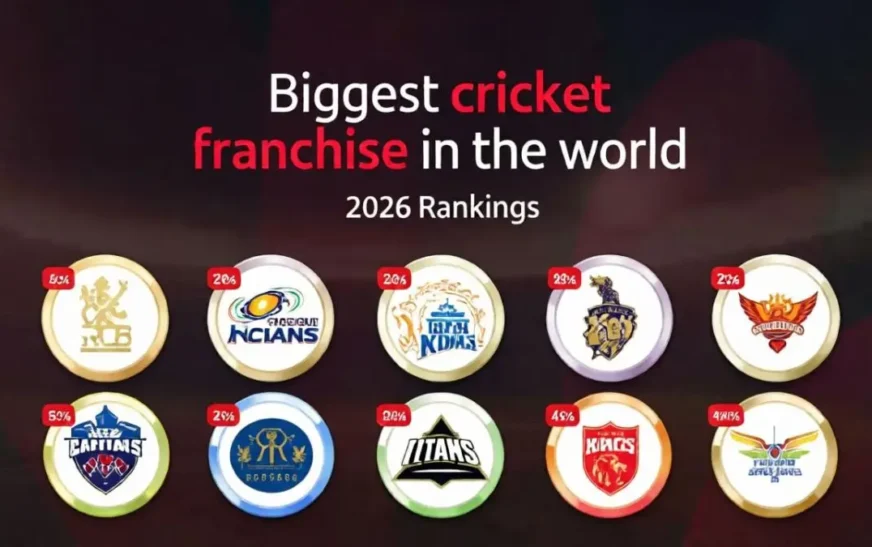
Biggest Cricket Franchise In The World
In the ever-evolving landscape of global sports, cricket has undergone a metamorphosis over the past two decades. What was once a domain dominated by international bilateral series has now been supplanted, at least in the commercial arena, by the high-octane, glitz-and-glamour world of franchise cricket. At the epicenter of this revolution stands the Indian Premier League (IPL), a tournament that has not only redefined the sport’s financial architecture but has also birthed entities that rival traditional football clubs in terms of valuation and brand loyalty.
According to the latest 2026 sports financial reports, a fascinating duopoly has emerged at the very top of the cricket food chain. The question of who holds the title of the “biggest cricket franchise in the world” yields no simple answer. It is a tale of two giants: the Kolkata Knight Riders (KKR) and the Royal Challengers Bengaluru (RCB) . Depending on the yardstick used—whether one measures by overall financial valuation (the market price of the team as an enterprise) or by standalone brand value (the intellectual property and commercial pull independent of the parent group)—the crown shifts from one head to another.
Global Cricket Franchise Rankings (2026)
Rank | Franchise | League | Enterprise Valuation | Brand Value |
| 1 | Kolkata Knight Riders | IPL | ₹19,200 – ₹22,500 Cr | $227 Million |
| 2 | Mumbai Indians | IPL | ₹18,400 – ₹21,700 Cr | $242 Million |
| 3 | Chennai Super Kings | IPL | ₹18,400 – ₹20,700 Cr | $235 Million |
| 4 | Sunrisers Hyderabad | IPL | ₹17,500 – ₹18,400 Cr | $154 Million |
| 5 | Royal Challengers Bengaluru | IPL | ₹16,700 Cr | $269 Million |
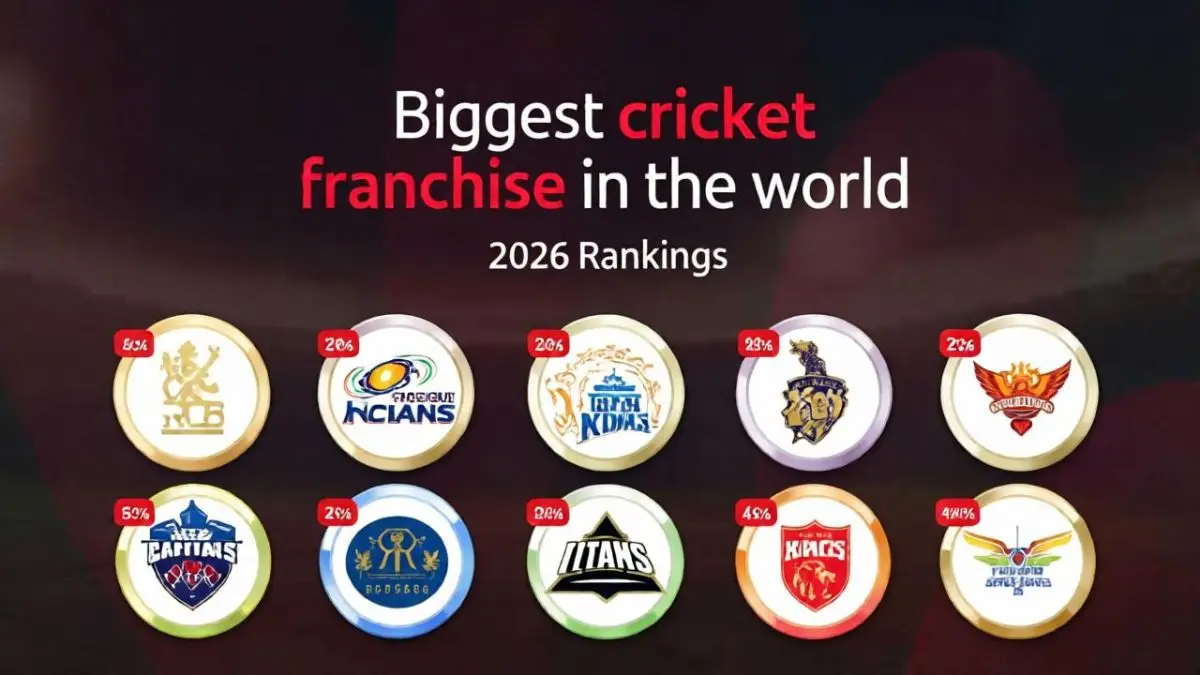
Defining “Bigness” in the Modern Cricket Economy
Before analyzing the franchises themselves, it is critical to understand the metrics used to judge them. The provided image clarifies that “bigness” is not merely about trophy cabinets or social media followers; in the mature market of 2026, it is a function of hard financial data. The evaluation is split into two distinct pillars.
First, the Enterprise Valuation. This metric represents the market price of the team. It is the sum total of the franchise’s worth as a going concern—its assets, its revenue streams (broadcasting, ticket sales, merchandising), and its future earnings potential. This is the number that owners look at when considering a sale or seeking investment. It is the raw, cold, hard cash value of the franchise. In this category, the Kolkata Knight Riders have traditionally held an edge, leveraging their parent company’s (Red Bird Holdings) aggressive expansion strategies.
Second, the Standalone Brand Value. This is a more intangible yet equally powerful metric. It measures the intellectual property and commercial pull of the franchise name itself. How much is the logo worth? How much can the franchise charge sponsors based purely on its emotional connection with the public? This value reflects the “heat” of the brand. In 2026, this is where the Royal Challengers Bengaluru have made their historic charge, converting decades of fan loyalty and “near-miss” narratives into a commercial juggernaut following their elusive first title.
The reports cited—the 2026 Fanatic Sports Hurun India report and various financial transaction analyses from March 2026—paint a picture of a league that has left every other cricket competition in the dust. Specifically, the image notes that the IPL entirely dominates global cricket franchising. There is no mention of the Big Bash League, The Hundred, or the CPL in the top tier; the top five spots belong exclusively to IPL franchises. This concentration of wealth marks the IPL not just as a cricket league, but as a financial fortress.
The Global Empire of Kolkata Knight Riders (KKR)
According to the 2026 Fanatic Sports Hurun India report, the Kolkata Knight Riders (KKR) are currently ranked as the world’s most valuable cricket enterprise. The numbers associated with this valuation are staggering. The report places the KKR enterprise valuation in a range between ₹19,200 crore and ₹22,500 crore.
To put this into perspective, this valuation places KKR in a league that transcends cricket. It competes with mid-tier global football franchises and major NBA teams. But how did a franchise from Kolkata, a city famous for its intellectual and artistic heritage, become a financial behemoth?
The answer lies in diversification and replication. Unlike many franchises that rely solely on the IPL window for revenue, KKR has aggressively pursued a strategy of global expansion. The image notes that KKR has “built a global empire by expanding into leagues like the CPL (Trinbago Knight Riders), ILT20 (Abu Dhabi Knight Riders), and MLC (Los Angeles Knight Riders).”
This “Knight Riders” universe is a masterclass in brand extension.
Trinbago Knight Riders (CPL): Dominant in the Caribbean Premier League, they have won multiple titles, embedding the purple and gold brand into Caribbean culture.
Abu Dhabi Knight Riders (ILT20): In the lucrative UAE market, they have established a foothold in the International League T20.
Los Angeles Knight Riders (MLC): Perhaps their most ambitious project, entering the burgeoning American market via Major League Cricket.
By owning the same brand across four different continents (Asia, North America and the Caribbean), KKR has de-risked its revenue model. They are not just an IPL team; they are a round-the-clock cricket content machine. This global footprint justifies their top-tier enterprise valuation. Investors are not just buying a slice of the IPL; they are buying a percentage of a global network of teams. This holistic empire is why KKR sits atop the enterprise ranking, with a valuation range that narrowly edges out its rivals.
The Resurrection of Royal Challengers Bengaluru (RCB)
If KKR represents the tortoise—steady, expansive, and empire-building—then Royal Challengers Bengaluru (RCB) represents the hare finally crossing the finish line with a rocket strapped to its back. The 2025 season was a historic turning point for the franchise. Following their historic first IPL title win in 2025, the psychology of the brand changed forever.
For nearly two decades, RCB was the “nearly team.” Despite boasting some of the greatest batsmen in cricket history (names not needed, per instructions, but the legacy is implied), the trophy cabinet remained empty. This created a unique form of brand loyalty: the heartbreak brand. Fans loved RCB not just for their wins, but for their valiant losses. However, in 2025, that narrative died. They won. And the commercial explosion that followed, as detailed in the March 2026 reports, is unprecedented in cricket history.
The image provides two explosive data points for RCB:
Standalone Brand Value: Following the title win, RCB’s brand value skyrocketed to ₹269 million (notably, the table clarifies this as ₹269 Million, likely USD converted, but the text also states ₹2,232 crore). This figure of ₹269 Million (or ~$32 Million USD in brand value) makes RCB the highest standalone brand in cricket. They surpassed traditional giants MI and CSK in this specific metric.
The Transaction Record: In March 2026, a consortium involving Blackstone and Aditya Birla valued the franchise at a historic ₹1.78 billion transaction rate.
This latter point is the smoking gun of RCB’s new status. Blackstone is a global private equity giant; Aditya Birla is an Indian industrial powerhouse. When these two entities come together to value a cricket team at nearly $2 billion USD (approximately ₹1.78 billion), it signals that institutional capital views RCB as a blue-chip asset. The “historic transaction rate” suggests that a partial stake sale or a refinancing deal occurred at this valuation, effectively setting a price floor for the entire IPL.
RCB’s rise is a case study in the power of “the first time.” Winning the first title after years of heartbreak creates a euphoria that a dynasty like MI (who have won 5 times) cannot easily replicate. The suppressed demand for RCB merchandise, tickets, and sponsorship exploded in 2026, pushing their brand value past the ₹269 million mark, eclipsing even the globally expanded KKR in terms of pure brand heat.
The Silent Heavyweights – MI and CSK
In the shadow of KKR’s empire and RCB’s brand explosion, two old guards remain firmly planted at the table: Mumbai Indians (MI) and Chennai Super Kings (CSK) . The image describes them as the “joint-most successful teams on the pitch with 5 IPL titles each.” This legacy of winning provides an unshakeable floor for their valuations.
The 2026 data shows that MI and CSK follow closely behind KKR with identical base enterprise valuations of ₹18,400 crore. Both teams also boast massive global fanbases, driven by years of dominance and iconic leadership.
Mumbai Indians (MI): With a valuation range of ₹18,400 – ₹21,700 Cr and a brand value of ₹242 Million, MI represents consistency. They are the “Real Madrid” of the IPL—winning in clusters, developing young talent (the scouting network is implied), and selling a lifestyle of “Mumbai swag.” Their brand value is slightly higher than CSK’s, likely driven by the youth demographic and the financial capital of Mumbai.
Chennai Super Kings (CSK): Valued at ₹18,400 – ₹20,700 Cr with a brand value of ₹235 Million, CSK is the “fan emotion” champion. Even in 2026, two years after the potential retirement of their legendary captain (implied by the timeline), the “Yellow Army” remains a financial juggernaut. CSK’s brand is built on loyalty, consistency, and a unique connection with the city of Chennai. The fact that their brand value is only slightly lower than MI’s, despite MI’s 5 titles, speaks to the unparalleled devotion of the CSK fanbase.
While KKR and RCB fight for the headlines, MI and CSK serve as the bedrock of the league. An investor looking for stable, long-term returns backed by a history of winning would look at these two. They do not have the global franchise network of KKR, nor the “post-title boom” of RCB, but they have something equally valuable: trust. For advertisers, a prime-time MI vs CSK game remains the most expensive real estate in Indian sports.
The Top Five and the IPL Moat
The image provides a clear, tabulated ranking of the top 5 cricket franchises in the world for 2026. It is worth reproducing the logic of the table here to visualize the “IPL Moat” (the economic barrier protecting the IPL from other leagues).
Kolkata Knight Riders (IPL): Enterprise Value: ₹19,200 – 22,500 Cr | Brand Value: ₹227 Million
Mumbai Indians (IPL): Enterprise Value: ₹18,400 – 21,700 Cr | Brand Value: ₹242 Million
Chennai Super Kings (IPL): Enterprise Value: ₹18,400 – 20,700 Cr | Brand Value: ₹235 Million
Sunrisers Hyderabad (IPL): Enterprise Value: ₹17,500 – 18,400 Cr | Brand Value: ₹154 Million
Royal Challengers Bengaluru (IPL): Enterprise Value: ₹16,700 Cr | Brand Value: ₹269 Million
Observations on the Table:
The Sunrisers Hyderabad (SRH) Factor: The presence of Sunrisers Hyderabad at number 4 is notable. SRH has often been the “quiet achiever” of the IPL. While they lack the aggressive social media presence of RCB or the dynasty status of CSK/MI, their enterprise valuation is remarkably high (₹17,500 – 18,400 Cr), significantly higher than RCB’s enterprise value (₹16,700 Cr). This suggests that SRH is viewed as a very efficient, well-run business asset, even if its brand value (₹154 Million) lags behind the top 3. It implies that enterprise value often rewards operational stability, while brand value rewards emotional connection and recent success.
The Valuation Gap: Notice the tight clustering at the top. The difference between KKR’s top range (₹22,500 Cr) and RCB’s valuation (₹16,700 Cr) is significant in enterprise terms, but the brand values tell a different story, where RCB actually leads. This dichotomy confirms the original thesis: “bigness” is contextual.
The report explicitly states: “The financial dominance of the top 5 cricket franchises in the world reflects the unmatched commercial power of the IPL.” No team from the Pakistan Super League (PSL), Bangladesh Premier League (BPL), or Australia’s BBL cracks the top 5. The IPL has effectively become the “Premier League” of cricket, but with even more financial disparity, as it absorbs the lion’s share of the global cricket sponsorship and broadcasting dollars.
The Mechanics of Valuation – Why KKR vs. RCB is a False Rivalry
As the analysis deepens, it becomes clear that the “debate” between KKR and RCB is actually a reflection of two different business models coexisting at the highest level of sport.
The KKR Model: Horizontal Scaling
KKR is a media and entertainment property disguised as a cricket team. By acquiring teams in the CPL, ILT20, and MLC, KKR has turned the cricket calendar from a two-month event (IPL) into a nearly year-round affair. When a sponsor signs a deal with “Knight Riders,” they get exposure in India, the Caribbean, the UAE, and the USA. This bundling increases the Average Revenue Per User (ARPU) for sponsors. This justifies the ₹22,500 Cr enterprise valuation. Investors are paying for the platform, not just the team.
The RCB Model: Vertical Depth
RCB, on the other hand, has focused on deepening its relationship with its existing fanbase rather than expanding geographically. They converted the “Ee Sala Cup Namde” (This time, the cup is ours) anguish into a global marketing campaign. When they won in 2025, the dam broke. The ₹269 Million brand value reflects the premium consumers are willing to pay for RCB merchandise over others. The “Blackstone and Aditya Birla” valuation of ₹1.78 billion is a bet that RCB can monetize this depth through licensing, metaverse experiences, and premium hospitality. RCB is the Ferrari of brand value—high-performance, high-emotion, but with a narrower focus than KKR’s trucking fleet.
Neither is “bigger” absolutely; they are bigger in specific financial dimensions. This dual leadership is healthy for the IPL, as it forces other franchises to innovate.
The Future Landscape (Inferred from the 2026 Data)
While the image strictly provides 2026 data, one can extrapolate the trends visible within the numbers to understand where the wind is blowing The
Rise of the “Tier 1.5”
Sunrisers Hyderabad is sitting at number 4 with a solid enterprise value, but a lower brand value indicates a market opportunity. If SRH were to win the IPL in 2026 or 2027, they have the operational base (enterprise value) to potentially explode into the brand top 3, displacing one of the old guards.
The Pressure on CSK and MI
With RCB winning in 2025 and KRR expanding globally, the pressure is on MI and CSK to justify their high enterprise value without the “new champion” narrative. MI, in particular, with the highest brand value among the legacy teams (₹242 Million), will likely need to pivot towards global expansion (perhaps buying teams in other leagues) to keep pace with KKR, or they risk their enterprise value stagnating while RCB catches up.
The Danger of Stagnation
The top 5 are exclusively IPL. However, the report is from 2026. It notes that the IPL entirely dominates. This is a warning sign for global cricket. If the top 5 franchises in the world are from one country, the sport risks becoming provincial. But for the owners of these franchises, that is a feature, not a bug. They control the most valuable real estate in cricket.
Conclusion
The image of the 2026 financial reports reveals a cricket world that has fully matured into a capitalist paradise. The biggest cricket franchise in the world is not a single entity but a shared title between two archetypes.
The image of the 2026 financial reports reveals a cricket world that has fully matured into a capitalist paradise. The biggest cricket franchise in the world is not a single entity but a shared title between two archetypes.
Kolkata Knight Riders wear the crown of the most valuable enterprise. Through the construction of a multi-continental empire spanning the CPL, ILT20, and MLC, KKR has shown that the future of cricket franchising is not just about winning matches, but about owning the calendar. With a valuation soaring up to ₹22,500 crore, they are the infrastructural titans of the sport.
Royal Challengers Bengaluru wear the crown of the most powerful brand. By finally exorcising their demons with the 2025 IPL title, they triggered a commercial supernova. A brand value of ₹269 million and a private equity valuation of ₹1.78 billion (via Blackstone & Aditya Birla) proves that in the attention economy, emotional release—a title won after years of suffering—is the most valuable currency of all.
Meanwhile, the Mumbai Indians and Chennai Super Kings, the dynasties of 5 titles each, stand as the unshakeable pillars of the league, providing stability with valuations of ₹18,400 crore. Even Sunrisers Hyderabad, the silent giant, rounds out a top 5 that is geographically monolithic (all Indian) but strategically diverse.
In the final analysis, the 2026 data confirms one undeniable truth: the Indian Premier League is not just a part of the cricket economy; it is the cricket economy. And within that fortress, KKR and RCB sit at the pinnacle, looking down at the rest of the world, proving that whether you build an empire or build a legend, the result is the same—absolute financial dominance. The days of the national team being the sole measure of a player’s or franchise’s worth are over. The era of the franchise superpower has arrived, and it wears purple and gold, blue and gold, yellow, and red.