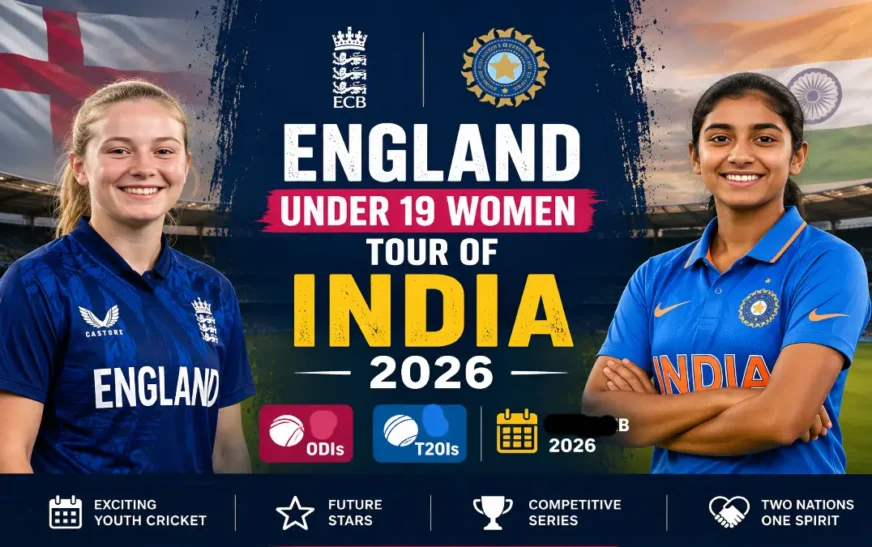
England U19 Women vs India U19 Women 2026 Pitch Reports, Full Squad and Everything You Need to Know
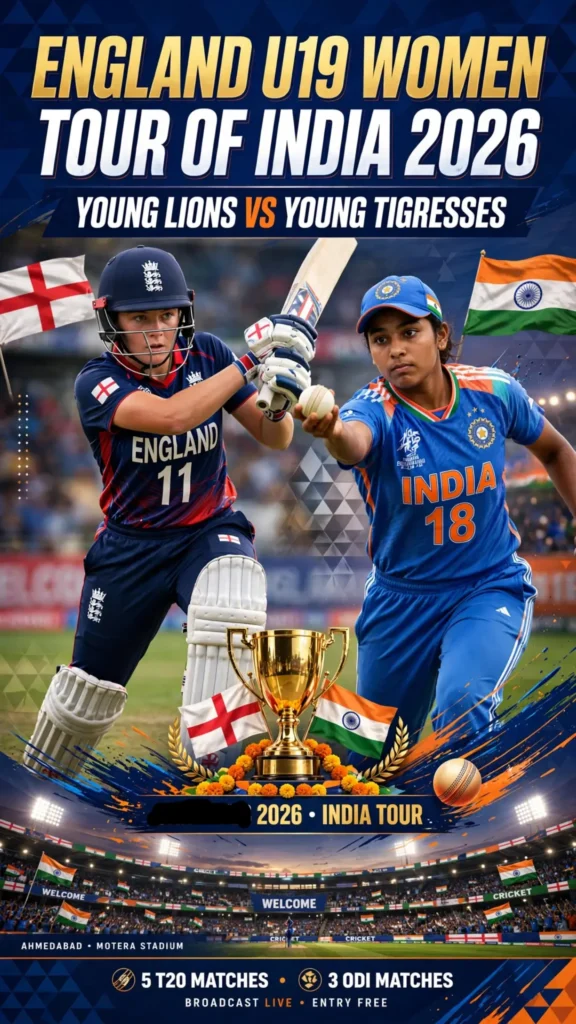
India’s reigning Under-19 Women’s World Champions are set for a marquee home assignment when England U19 Women arrive for a five-match Youth T20I series in November-December 2026. Split across two Gujarat venues — Baroda (Vadodara) and Surat — the series will be one of the longest bilateral white-ball assignments on the Indian U19 women’s calendar this season, and it arrives at a fascinating time for both age-group programmes.
For India, it is a chance to extend a dominant run that has already produced back-to-back Under-19 Women’s T20 World Cup titles. For England, it is an opportunity to test a new crop of teenagers against the best young side in the world, on pitches that will be entirely unfamiliar to most of the touring squad. Here is a complete breakdown of the schedule, venue conditions, likely squads, and the storylines to follow.
Full Schedule and Fixtures
The five-match Youth T20I series will be played across two cities in Gujarat, with the first three matches hosted in Baroda before the series shifts to Surat for the final two fixtures.
| Match | Date | Venue | Time (IST) |
|---|---|---|---|
| 1st Youth T20I | November 26, 2026 | Baroda (Vadodara) | 6:00 PM |
| 2nd Youth T20I | November 28, 2026 | Baroda (Vadodara) | 1:00 PM |
| 3rd Youth T20I | December 1, 2026 | Baroda (Vadodara) | 6:00 PM |
| 4th Youth T20I | December 3, 2026 | Surat | 6:00 PM |
| 5th Youth T20I | December 6, 2026 | Surat | 1:00 PM |
The series was confirmed as part of a broader BCCI announcement covering fixtures for the senior women’s team, India A men and women, and multiple India Under-19 sides for the 2026-27 domestic season. Alongside this England assignment, the BCCI also lined up a Youth T20I and Youth ODI series against Sri Lanka U19 Women earlier in the year, meaning the group touring for this England series should already have some competitive match rhythm behind them.
Two of the five games — the second Youth T20I in Baroda and the fifth in Surat — carry a 1:00 PM IST start, meaning they will be played predominantly in daylight, while the other three are evening fixtures under lights starting at 6:00 PM IST. That mix is worth noting from a conditions standpoint, since dew is a significant factor for night matches in Gujarat in late November and early December, typically making chasing a touch easier once the ball starts to skid on more freely in the second innings.
Baroda: Venue and Pitch Report
The opening three matches of the series will be played in Baroda, a city with a long cricketing pedigree that has hosted top-level international cricket for decades. Historically, Baroda’s premier ground has been a venue where batters have enjoyed themselves, with a true, even surface that holds up well through a full innings.
A few pitch characteristics to expect in Baroda:
- Batting-friendly surface: The ground has traditionally offered good pace and carry through the surface, rewarding batters who commit to their shots early. In white-ball cricket, teams batting first have historically found runs a little easier to come by once the pitch settles into the middle overs.
- True bounce, minimal lateral movement: There is generally not a great deal of sideways movement for seamers off the surface, which tends to favour batting units with strong technique against the new ball rather than swing bowlers looking for big deviation.
- Dry, warm conditions: Late November in Gujarat typically brings dry, clear weather with daytime temperatures still comfortably in the high 20s to low 30s Celsius, meaning rain interruptions are unlikely and the pitch should not be affected by excess moisture.
- Evening dew factor: For the two 6:00 PM starts, dew could start to settle by the back end of the chase, generally making it marginally easier for the side batting second, especially for spinners trying to grip the ball.
Given these tendencies, both India and England are likely to lean toward batting-first strategies when winning the toss in the daytime fixture, while the evening matches could see a slight tilt toward chasing depending on how heavy the dew is on a given night.
Surat: Venue and Pitch Report
The series shifts to Surat’s Lalbhai Contractor Stadium for the final two matches. This venue carries genuine pedigree in the women’s game — it hosted a full series of Women’s T20Is between India and South Africa in 2019, so the ground is no stranger to top-flight women’s cricket, even though it has not seen a great deal of international action since.
Key points on the Surat pitch:
- Batting-friendly, small ground: The Lalbhai Contractor Stadium is widely regarded as a batting paradise, with a surface that offers consistent bounce and comparatively short boundaries that reward clean hitting. High-scoring games are the norm rather than the exception here.
- Some early seam movement: While the pitch generally favours batters overall, quick bowlers can extract a little assistance with the new ball in the first few overs before the surface flattens out and becomes easier to score on through the middle.
- Toss matters: Sides winning the toss at this venue have generally opted to bat first, looking to post a competitive total and defend it on a ground where boundaries can be found relatively easily.
- Historical scoring: The venue’s white-ball history suggests totals well above par should be common, which bodes well for young batting units on both sides looking to play with freedom rather than under pressure to grind out totals on a difficult surface.
Taken together, both Baroda and Surat lean toward being run-scoring venues rather than bowler-friendly ones, which should suit a series designed, in part, to give emerging batters exposure to building and chasing competitive totals — a valuable developmental experience regardless of the final results.
India U19 Women: Squad Outlook
India Under-19 Women arrive into this series as the reigning back-to-back champions of the ICC Under-19 Women’s T20 World Cup, having retained their title with a dominant, unbeaten campaign. That victory established India as the benchmark programme in age-group women’s cricket globally, and it means the core group of players who formed that title-winning squad will headline selection conversations for this series against England.
Captain Niki Prasad led India to the trophy with a calm, assured leadership style, and she remains the most likely candidate to continue leading the side into this home assignment, assuming she is still age-eligible for Under-19 selection by the time the series arrives. Around her, several players who were central to India’s World Cup triumph have emerged as genuine stars of the age-group circuit:
- G Trisha was one of the standout all-round performers during India’s World Cup defence, contributing with both bat and ball across the tournament and establishing herself as one of the most complete young cricketers in the country.
- Vaishnavi Sharma made an impact with the ball, playing a key role in a middle-order collapse she engineered during India’s run through the knockout stages, underlining India’s strength in young spin bowling.
- Sisodia and Kamalini were also prominent contributors during India’s title defence, with the team’s overall depth in both batting and bowling departments seen as a major factor behind their success.
It is worth noting clearly: as of now, the BCCI has not formally announced the playing squad for this specific series against England, since the fixtures were only confirmed months in advance as part of the broader 2026-27 domestic and international calendar. Squad announcements for Indian age-group teams typically arrive closer to the tour dates, generally a few weeks before the first match, once the Women’s Selection Committee reviews recent domestic performances, including India U19’s earlier assignment against Sri Lanka U19 Women. Readers should treat any specific XI as provisional until the BCCI’s official announcement closer to late November 2026.
What can be said with confidence is that India’s selectors will likely blend proven performers from the World Cup-winning core with fresh talent unearthed through domestic Under-19 tournaments over the course of 2026, continuing the conveyor-belt approach that has made India’s junior women’s programme the envy of most cricketing nations.
England U19 Women: Squad Outlook
England’s Under-19 Women’s programme has been building steadily under its age-group coaching setup, with a structured pathway through the England Women’s Performance Programme feeding talent into the senior international system. The squad that toured for various age-group assignments through 2025-26 has been shaped significantly by head coach Chris Guest, who has overseen England’s development squads across both white-ball formats.
As with India, England’s specific touring squad for this series has not been formally announced at the time of writing. However, based on recent Under-19 and pathway squads, a few trends are likely to carry into squad selection:
- England’s age-group management has consistently prioritised all-round balance, blending power-hitting top-order batters with a spread of seam and spin options, mirroring the template used by the senior England Women’s side.
- Several players who have featured in recent England Women’s Performance Programme and Development XI fixtures — including domestic standouts who impressed in county and regional pathway cricket through the 2026 season — are likely to be in contention.
- England will be conscious of the tour’s timing, arriving in India during their off-season, which gives selectors a genuine opportunity to expose fringe talents to unfamiliar subcontinental conditions ahead of future World Cup cycles.
England’s biggest challenge on this tour will not be talent — the pathway has produced strong performers in recent age-group tournaments — but rather adaptation. Subcontinental conditions, particularly the turn and variable bounce that can develop on used Gujarat surfaces as a five-match series wears on, will test a squad that has spent most of its cricket on English pitches offering more seam movement and less spin.
Key Storylines to Watch
Can India extend their dominance at home? India’s Under-19 Women’s side has rarely lost bilateral series on home soil in recent years, and with the psychological weight of back-to-back World Cup titles behind them, they will start this series as clear favourites. The real intrigue lies in how India’s selectors manage player workload and opportunity across five matches — expect rotation designed to give fringe squad members exposure without compromising the core group’s rhythm.
England’s development curve. For England, results may matter less than the process. A five-match series is an unusually long assignment for an age-group side, and it offers England’s coaching staff a genuine sample size to assess how their young batters cope against high-quality Indian spin bowling — an area that has historically been the biggest gap between English and Asian age-group cricket.
Conditions as a leveller and a lesson. Both venues lean batting-friendly, which should produce entertaining, high-scoring cricket rather than low-scoring grinds. That works in England’s favour to an extent, since flatter pitches reduce the gap created by unfamiliarity with turning tracks — though the series-ending matches in Surat, played on a surface with some historical international pedigree, could still throw up tighter contests than the early exchanges in Baroda.
Dew and toss dynamics. With three of the five matches starting under lights, dew management will be a recurring theme. Sides winning the toss in the evening fixtures are more likely to consider bowling first, aiming to exploit any residual seam movement before conditions become batter-friendly, then use the second-innings dew to their advantage when chasing.
Where to Watch
Official broadcast and streaming details for Youth T20I series are typically confirmed by BCCI closer to the tour dates, generally through the Jio platforms that have carried India’s domestic and age-group cricket in recent seasons. Fans should check official BCCI and broadcaster channels nearer the series start for confirmed streaming and television information, as age-group series do not always receive the same broad broadcast coverage as senior international fixtures.
Frequently Asked Questions
Q: When does the England U19 Women vs India U19 Women 2026 series start? A: The series begins on November 26, 2026, with the 1st Youth T20I in Baroda.
Q: How many matches are in the series? A: It is a five-match Youth T20I series, with three games in Baroda and two in Surat.
Q: Where are the matches being played? A: The first three matches are scheduled for Baroda (Vadodara), Gujarat, while the final two matches move to Surat.
Q: Who is the captain of India U19 Women? A: Niki Prasad captained India to their most recent Under-19 Women’s T20 World Cup title and is a strong contender to continue leading the side, though the official squad and captaincy for this specific series had not been confirmed at the time of writing.
Q: Have the full squads been announced? A: Not yet. Both the BCCI and ECB typically confirm age-group squads closer to the tour dates, usually a few weeks before the opening match. This article will be updated with confirmed squads once they are officially released.
Q: What time do the matches start in IST? A: Three matches (1st, 3rd, and 4th Youth T20I) start at 6:00 PM IST, while the 2nd and 5th Youth T20I begin earlier at 1:00 PM IST.
Q: Are these matches part of a larger India U19 Women season? A: Yes. This series follows India U19 Women’s earlier home assignment against Sri Lanka U19 Women and forms part of a packed 2026-27 season for India’s age-group women’s teams, alongside similar developmental tours for India A Women against Australia A and England A Women.