Rohit Sharma Photos India’s T20 World Cup jersey pointing to the BCCI badge — HD photo of the Indian cricket captain. Download & share
There is something unmistakably regal about the way Rohit Sharma carries himself on and off the cricket field. In the series of images that capture his essence — a beaming smile as he points proudly to the BCCI crest on his jersey, a triumphant bat raise after a milestone century, a dramatic sweep shot on bended knee with an entire nation’s hopes riding on the stroke, and a warm wave to the crowd dressed in full Indian blue — one sees not just a cricketer, but a cultural phenomenon. Rohit Sharma, popularly known as “The Hitman,” is perhaps the most beloved captain Indian cricket has ever produced. These photographs, each more evocative than the last, tell the story of a man who has given everything to the game — and a game that has, in many ways, made him immortal.
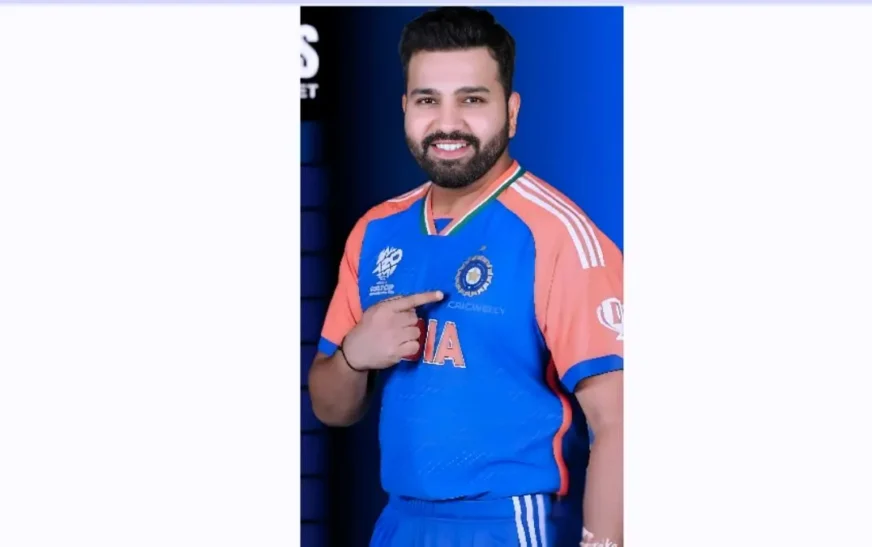
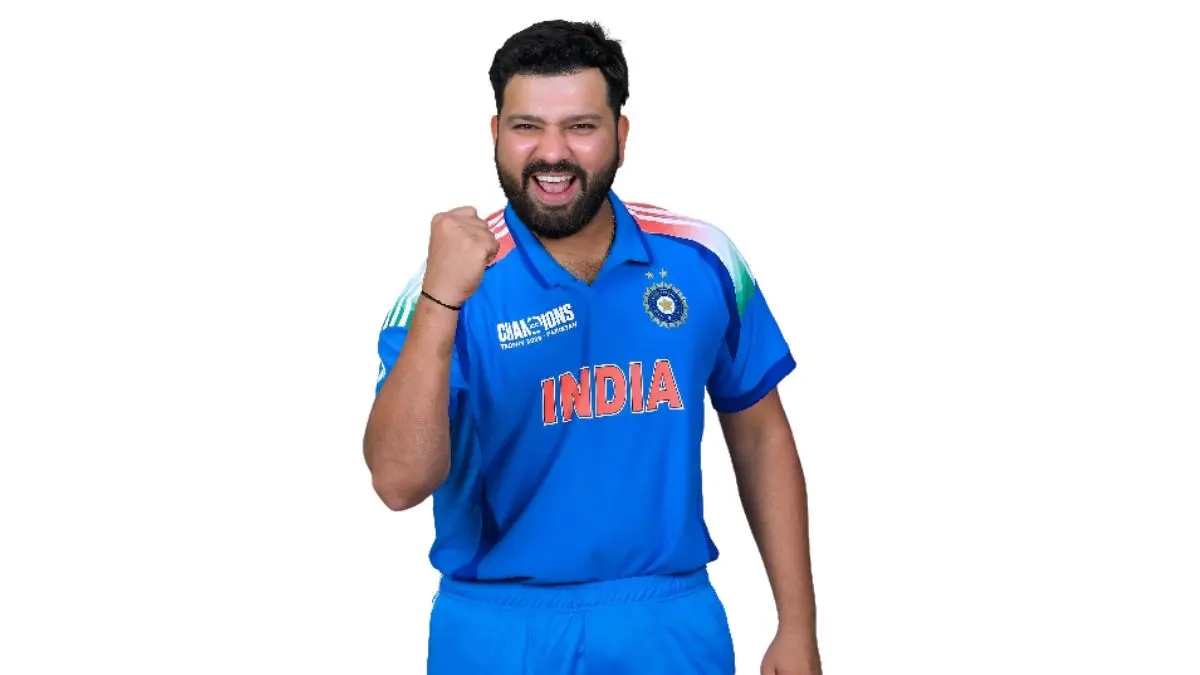
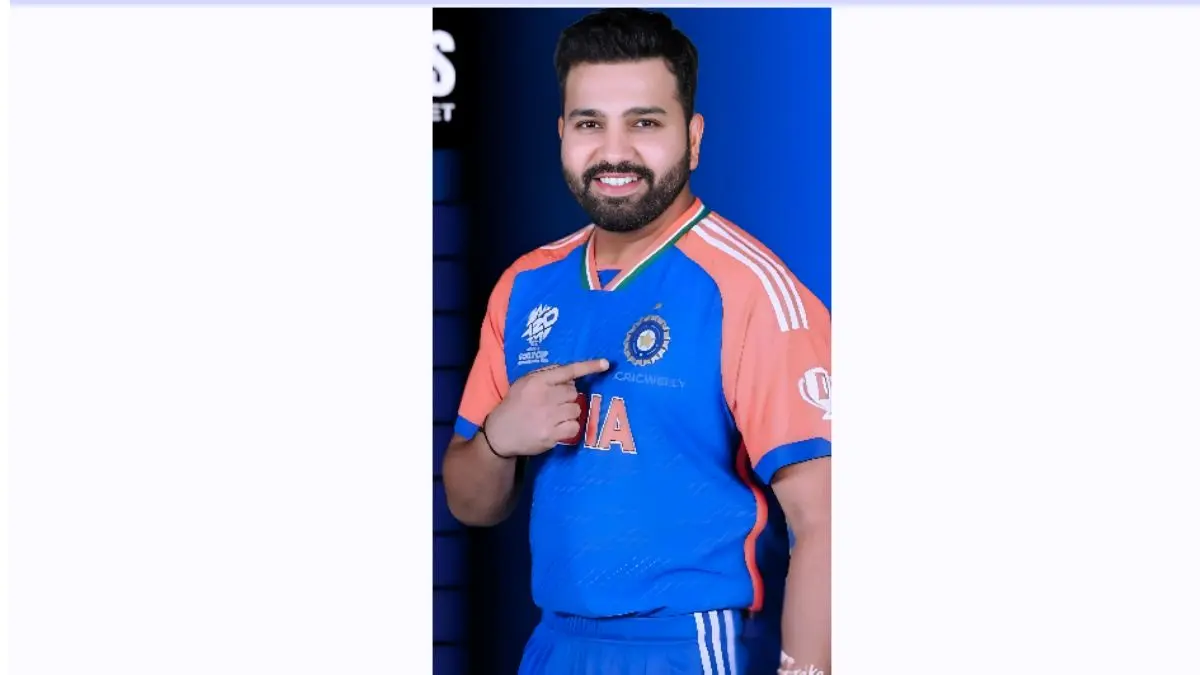
In the first image, Rohit stands against a bold blue background wearing the iconic India T20 World Cup jersey — the one with the distinctive orange accents and the tricolour trim around the collar. His finger points squarely at the BCCI logo, a gesture both playful and deeply proud. It is the gesture of a man who knows exactly what it means to wear that badge. The smile is wide, the beard impeccably groomed, and the entire frame radiates the infectious confidence that has made Rohit one of the most admired cricketers of his generation.
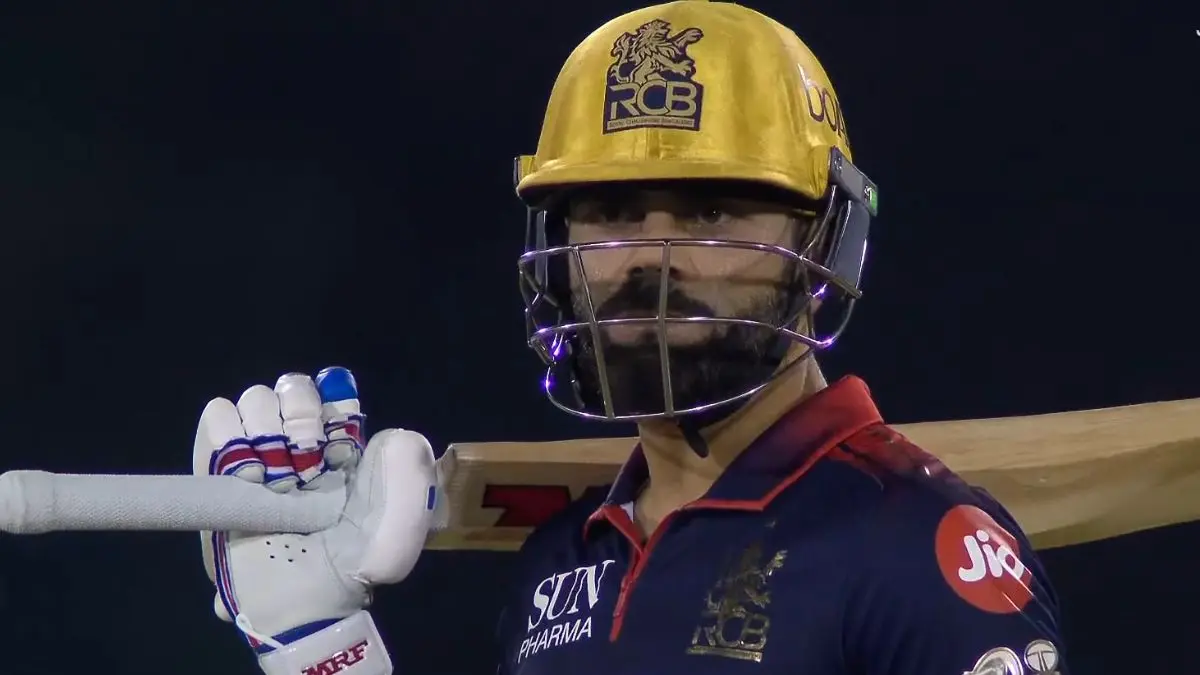
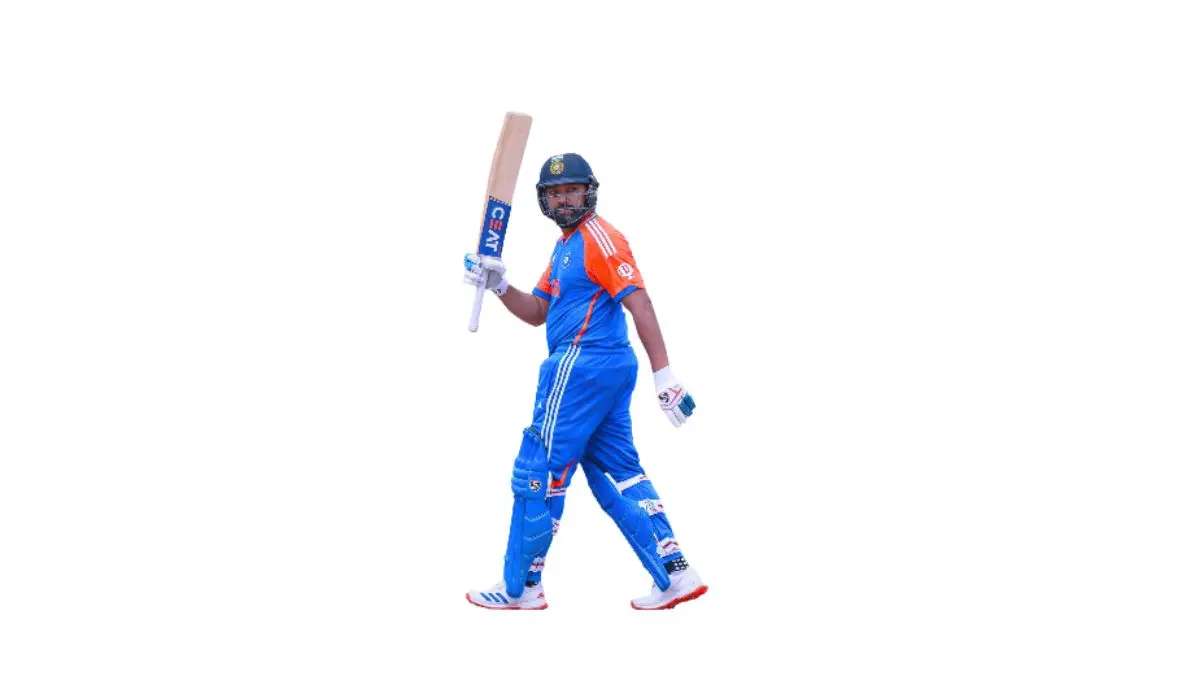
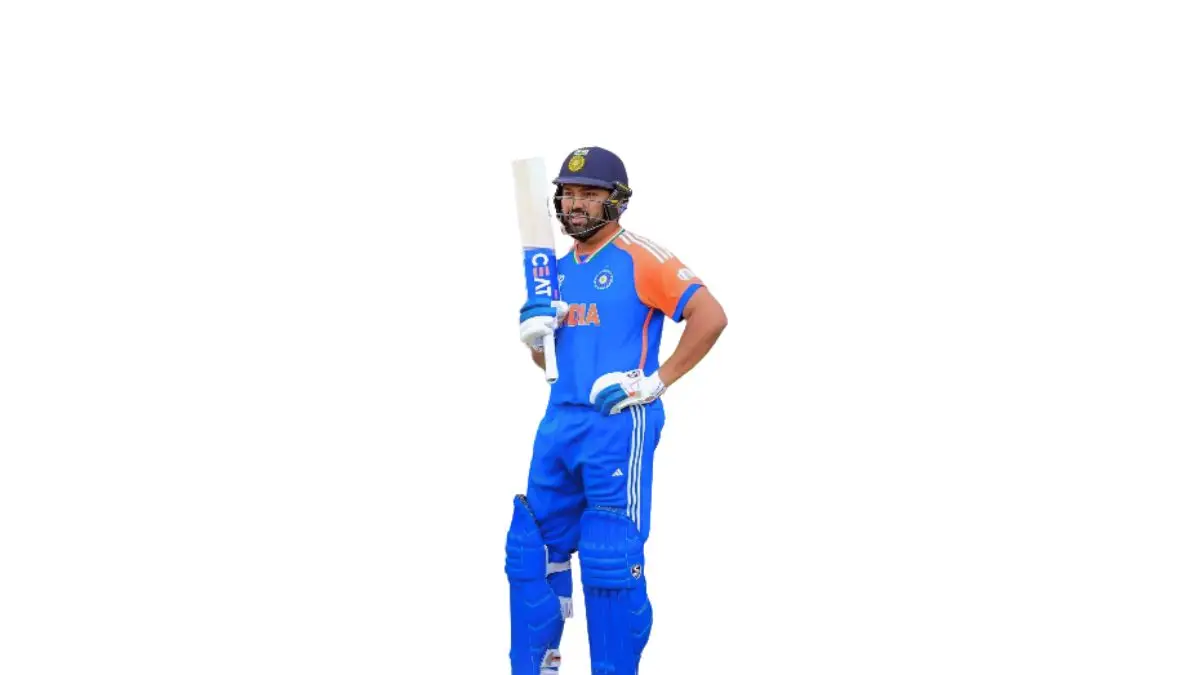
In the second image, he is captured in full cricketing gear, raising his bat aloft with one hand in what appears to be a celebratory acknowledgment of the crowd — the classic batsman’s salute after reaching a significant landmark. The clean white batting gloves, the blue pads, the SG bat, and the India jersey with orange sleeves paint a perfect tableau of a batsman at the peak of his powers.
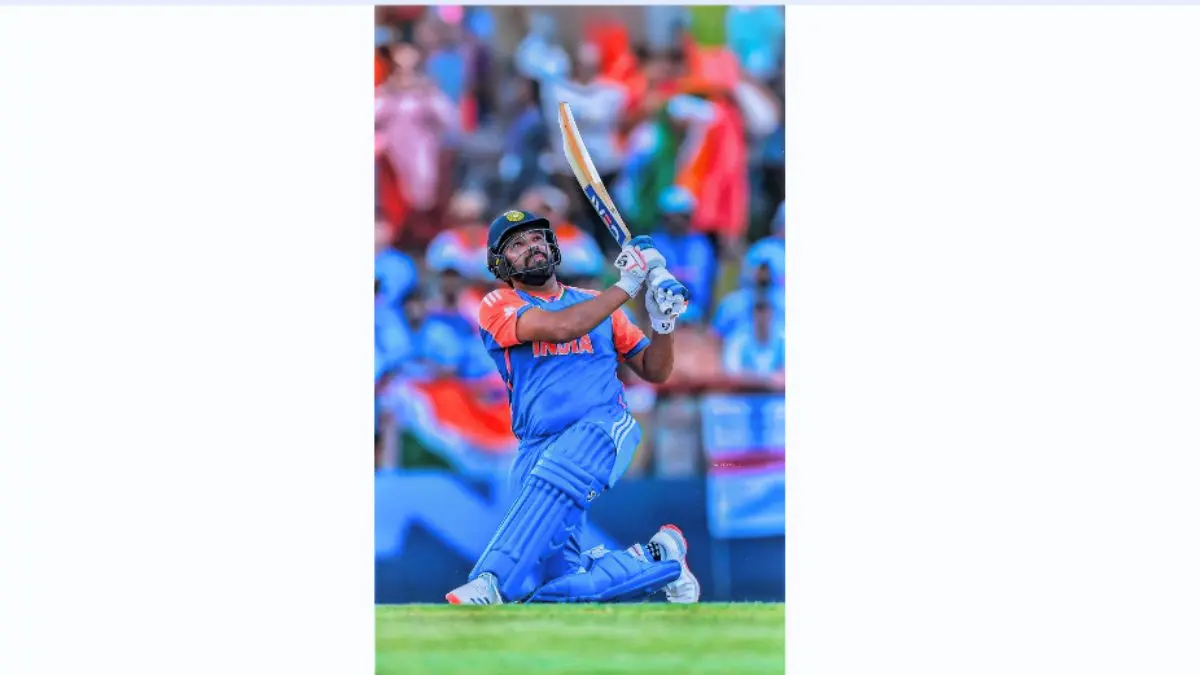
The third image is perhaps the most dramatic. Rohit is down on one knee, executing what looks like a sweep or a slog-sweep, his bat extended skyward, his eyes fixed upward in concentration and effort. The crowd in the background is a blur of orange and blue — unmistakably the Indian tricolour — and the energy is palpable even through the still frame. This is Rohit in his most complete form: technical mastery meeting explosive power.
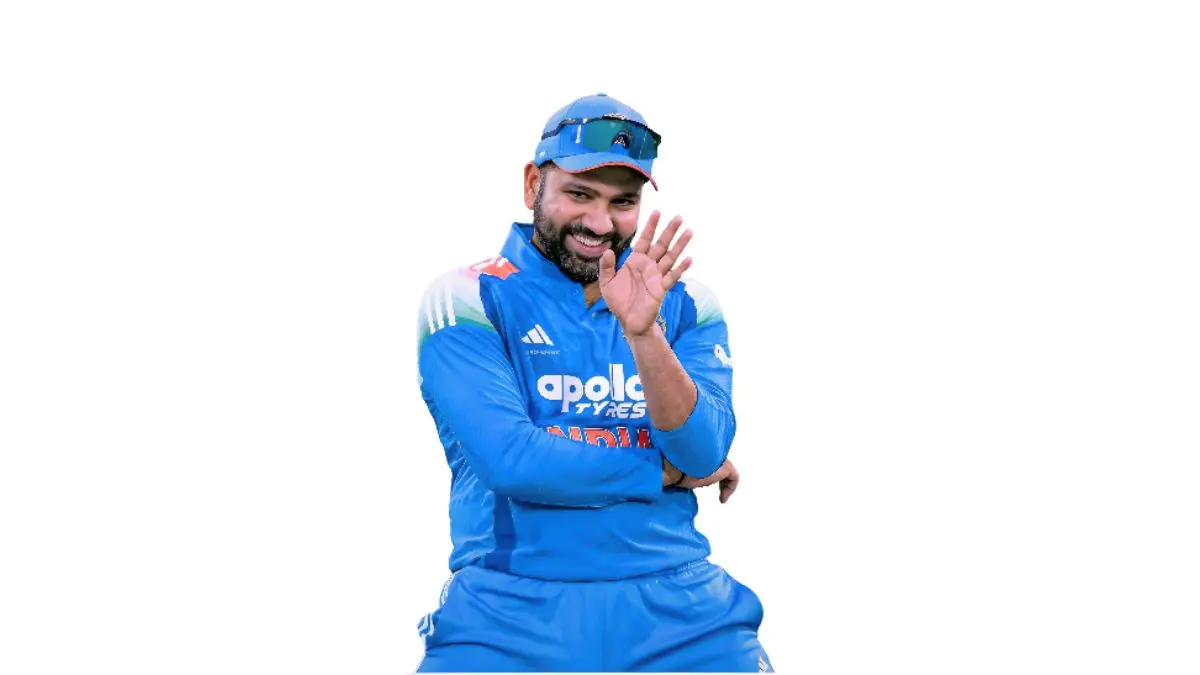
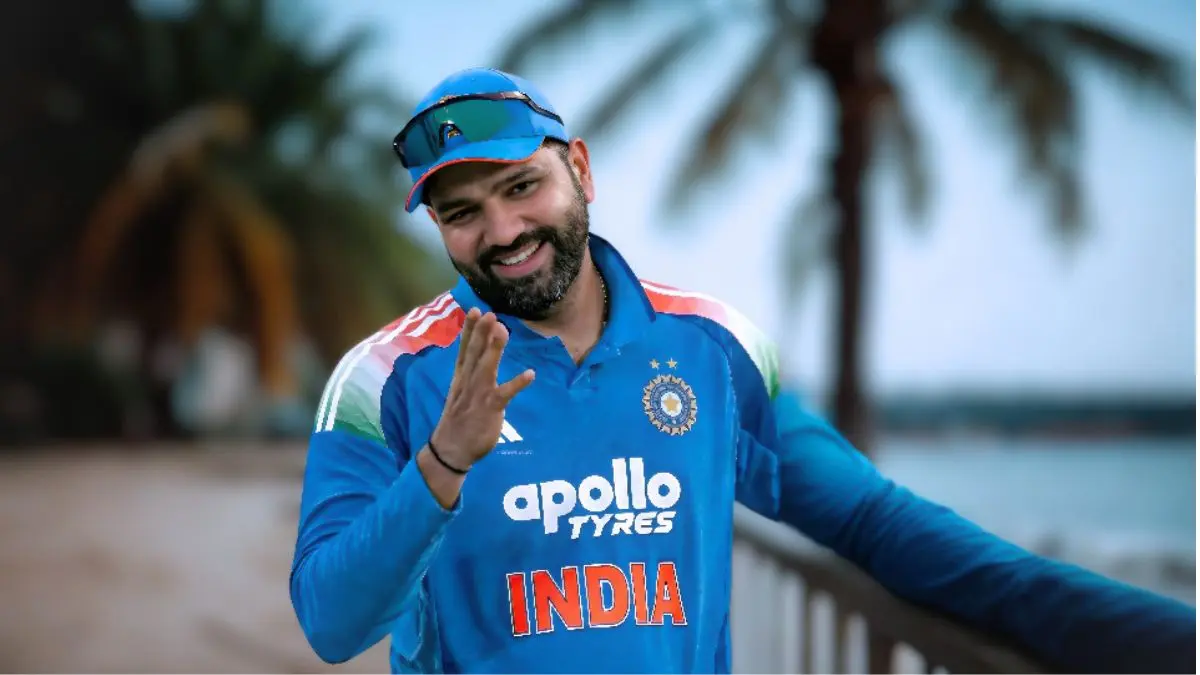
The fourth photograph shows a more relaxed, fan-friendly side. Rohit, dressed in the blue ODI jersey with the Apollo Tyres branding visible on the chest, smiles broadly and waves to the crowd, his sunglasses pushed up over the peak of his India cap. It is a moment of warmth and connection — Rohit the captain saying thank you to the millions who have stood by him through thick and thin.
Together, these four images offer a portrait of one of cricket’s greatest modern icons. And to understand what makes them so powerful, one must understand the man himself.
Early Life: From Borivali to the World Stage
Rohit Gurunath Sharma was born on April 30, 1987, in Bansod, Nagpur, though he grew up largely in Borivali, a suburb in the northern reaches of Mumbai. His childhood was marked by modest means — his father, Gurunath Sharma, worked as a caretaker in a transport company, and the family lived in a one-room home where finances were always tight. Yet, cricket found Rohit early, as it does with so many gifted athletes in the subcontinent.
It was Rohit’s maternal grandfather and uncles who first supported his cricketing ambitions, paying for his early training at the Swami Vivekanand International School in Borivali. Here, under the guidance of coach Dinesh Lad, the young Rohit’s talent was first formally recognised. Lad saw in the teenager not just ability, but a rare quality of timing and elegance — the kind that cannot be taught, only nurtured. At Lad’s insistence, Rohit changed schools to Dombivli, where his cricket could receive more structured coaching and where he would compete at higher levels.
The formative years were filled with struggle. Making it in Mumbai cricket — one of the most competitive cricketing environments in the world — requires not just talent but extraordinary resilience. Rohit had both. He rose through the ranks of the Mumbai age-group system, catching the eye of selectors with his ability to read the game and his capacity for large innings when the team needed them most.
His first-class debut for Mumbai came in 2006-07, and from the outset, it was clear that this was no ordinary cricketer. There was a languorous, almost lazy elegance to his strokeplay that belied the tremendous power he could generate. Where others struggled and grinded, Rohit seemed to have time — an extra fraction of a second that the best batsmen always seem to possess.
The International Breakthrough
Rohit Sharma made his international debut for India in 2007 in an ODI against Ireland during the inaugural ICC World Twenty20. Fittingly, India won that tournament under the captaincy of the young Mahendra Singh Dhoni — a victory that would set the template for a generation of Indian cricket to which Rohit would contribute enormously.
The early years of Rohit’s international career were not without turbulence. Despite his obvious talent, consistency eluded him. He flitted in and out of the Indian XI, often batting in the middle order, a position that many cricket analysts now believe limited his expression. The criticism was pointed: here was a man of immense gifts who could not quite nail down a regular spot in the team.
The transformation came in 2013 when the then Indian coach Duncan Fletcher and captain Dhoni moved Rohit to open the batting in ODIs. The decision was unconventional — Rohit had never opened regularly in international cricket — but it proved to be one of the most consequential tactical choices in the history of Indian cricket. At the top of the order, with the field restrictions of the powerplay to exploit, Rohit flourished in a manner that confounded even those who had believed in him.
The Record Books: A Batsman Unlike Any Other
What followed in the years after 2013 was nothing short of extraordinary. Rohit Sharma proceeded to set records that are likely to stand for decades, if not permanently.
In November 2013, batting against Australia in Bangalore, Rohit scored 209 runs — the highest individual score by an Indian in ODI cricket at that point, and a performance that left the cricketing world gasping. But that was merely the beginning. The following year, in November 2014, against Sri Lanka in Kolkata, Rohit surpassed his own record with an astonishing innings of 264 runs — the highest individual score in the history of ODI cricket. The knock contained 33 fours and nine sixes, and it came in just 173 balls. Watching that innings unfold was a privilege; it redefined what was possible in the fifty-over format.
As if that were not enough, Rohit also holds the record for scoring three double centuries in ODIs — a feat that no other cricketer has achieved, and that few are likely to replicate. Between 2013 and 2019, he scored 264, 209, and 208 runs in three separate ODI innings — numbers that belong more to fiction than to sport.
In T20 International cricket, Rohit has been equally dominant. He holds the record for the most centuries in T20Is — a format many believed was too explosive for centuries to become commonplace. He proved the critics wrong again and again.
His Test record, once questioned, eventually blossomed after he was elevated to the opening position in red-ball cricket as well. As a Test opener, Rohit has been one of India’s most consistent and dominant performers, scoring big hundreds in overseas conditions that had previously been his weakness.
The Captain: Leading India to New Heights
The captaincy that is so evident in the images — the pride in the badge, the authority of his posture, the warmth of his relationship with the crowd — came to Rohit fully when he was appointed India’s white-ball captain on a permanent basis and, subsequently, Test captain as well.
As captain, Rohit Sharma has been defined by an attacking, fearless philosophy. He has pushed for aggressive batting approaches, supported youngsters through lean patches, and built a team culture of expressing oneself freely. Under his leadership, India played some of their most exciting cricket, with the 2023 ODI World Cup campaign in particular standing as a high-water mark — India went unbeaten through the entire league stage and the knockout rounds until a heartbreaking final against Australia.
The 2024 T20 World Cup, for which the jersey in the first image was worn, proved to be the culmination of Rohit’s captaincy story. Leading India to a T20 World Cup triumph — ending an eleven-year ICC title drought — Rohit Sharma wrote the perfect chapter to a captaincy tenure that had been scrutinised relentlessly. The championship win was a moment of immense joy and relief, and Rohit’s subsequent announcement of his retirement from T20 International cricket in the aftermath of the victory was the perfectly scripted exit of a champion.
The images of him on the field after that final — pointing to the jersey, holding up his bat, sweeping the ball into the crowd — are burned into the collective memory of Indian cricket fans.
The Hitman: Analysing the Batting Style
To appreciate Rohit Sharma fully is to appreciate the aesthetic dimension of cricket. Batting is not merely a sport but an art form, and Rohit is one of its finest practitioners.
The images in this article capture his batting in two distinct moments: the bat raise of a milestone innings and the kneeling sweep shot of a man constructing a match-winning knock. Both tell the story of a cricketer who has mastered every aspect of the game.
Rohit’s most distinctive quality is the time he seems to manufacture against even the fastest bowlers. Where other batsmen are hurried, Rohit is unhurried. He sees the ball early — so early that he appears to be playing in a slightly slower game than everyone around him. This visual delay, this extra heartbeat before the stroke, is the hallmark of the truly great batsman.
His pull shot is perhaps the most celebrated stroke in his repertoire. Against short-pitched bowling, Rohit is devastating. The pull finds the boundary with a casual authority that makes even 90-plus miles-per-hour deliveries seem manageable. The shot in the third image — a sweep played on bent knee, the bat lifted skyward — shows another facet of this mastery: the ability to get low, to create angles, to manipulate the ball into gaps that others cannot find.
His cover drive, when it comes, is a thing of pure beauty. He gets to the pitch of the ball, bends his front knee, and rolls the wrists through the stroke in a motion that dispatches the ball to the boundary before fielders can react. Against spin, he is equally adept — using his feet, reading the turn, and driving or sweeping with equal authority.
What separates Rohit from the merely excellent is an innate sense of match situation. He plays differently when the team is building — accumulating with minimal fuss, rotating the strike — and differently when the team needs a launch pad, unfurling an array of brutal strokes that can shred any attack in the world.
The Mumbai Indians Connection: IPL’s Greatest Captain
No account of Rohit Sharma’s career is complete without discussing his relationship with the Mumbai Indians franchise in the Indian Premier League. Rohit joined Mumbai Indians in 2011 and, as captain, led them to a record five IPL titles — in 2013, 2015, 2017, 2019, and 2020.
The MI captaincy under Rohit became a masterclass in franchise cricket. He built teams around talent and temperament, trusted young players early, and created a culture of accountability combined with freedom. The MI dressing room under Rohit produced some of the most enduring partnerships in the IPL — Rohit and Kieron Pollard, Rohit and Jasprit Bumrah, Rohit and Hardik Pandya — partnerships built on mutual respect and a shared desire to win.
His batting in the IPL has also been exceptional. As an opener, Rohit has provided Mumbai Indians with the platform they have used repeatedly to build match-winning totals. His power in the first six overs, combined with his ability to anchor an innings when needed, has made him the ideal IPL captain-batsman.
Beyond Cricket: The Human Being
The fourth image — Rohit waving warmly to the crowd, sunglasses perched on his cap, the Apollo Tyres sponsor badge visible on his chest — is perhaps the one that speaks most to who Rohit Sharma is as a person. This is not the steely competitor or the record-breaking batsman. This is a man grateful to those who have supported him.
Rohit Sharma is known within Indian cricket as one of the most personable, approachable, and emotionally intelligent cricketers to have represented the country. His relationship with team-mates is one of genuine warmth. Younger players have frequently spoken about how Rohit’s mentorship shaped their careers — about the conversations in the dressing room, the encouragement after a bad day in the middle, the trust that was placed in them even before they had fully earned it.
Off the field, Rohit is a passionate conservationist. He has been involved with the WWF India campaign as a brand ambassador for wildlife conservation, particularly advocating for the protection of endangered species including the Amur falcon and the Indian rhinoceros. This is a man who, unlike many athletes, has used his platform deliberately and thoughtfully.
His family — wife Ritika Sajdeh and daughter Samaira — have been constants in his life and he has been open about the grounding influence they provide. After particularly meaningful victories, it is Rohit’s visible emotion — the tears, the embraces, the quiet moments of reflection — that remind audiences that behind the extraordinary athlete is an ordinary man who loves his family and feels everything deeply.
The Legacy: What Rohit Sharma Means to Indian Cricket
Standing back and taking in all four images together, one is struck by a singular truth: Rohit Sharma represents the full spectrum of what it means to be an Indian cricketer.
The pride in the badge — pointing to the BCCI crest — speaks to the honour and responsibility of representing 1.4 billion people. The bat raise after a milestone speaks to the toil and sacrifice that underpins every moment of brilliance. The kneeling sweep, executed perfectly under pressure with a roaring crowd in the background, speaks to the technical excellence and mental fortitude that separate the great from the merely good. And the warm wave to the crowd speaks to the humility and gratitude that have made Rohit not just a great cricketer but a great human being.
Rohit Sharma’s career numbers — as of his peak years — include well over 10,000 runs in ODIs, more than 3,000 in T20 Internationals, and a Test average that has consistently been above 45 in recent years. But numbers alone cannot capture his impact. Rohit changed the way India thinks about opening the batting in white-ball cricket. He showed that the opening position was not just about seeing off the new ball but about attacking it, exploiting the powerplay, and setting the tone for everything that followed.
As a captain, his record speaks for itself: an IPL dynasty at Mumbai Indians and an ICC T20 World Cup title with India. His captaincy was defined not by rigid strategy but by an intuitive feel for the game — knowing when to back off, when to attack, when to trust a young bowler, and when to bring back an experienced head.
Conclusion: A Legend Captured in Four Frames
There is a reason the images of Rohit Sharma resonate so deeply with Indian cricket fans. They do not merely show a cricketer; they show a story — of a boy from Borivali who grew up to become one of the most decorated and beloved cricketers in the history of the game.
The proud point at the jersey. The triumphant bat raise. The explosive sweep on a knee with the crowd electric behind him. The warm wave of gratitude to the fans who made the journey worth it.
Each frame is a chapter. Together, they are the biography of a champion.
Rohit Sharma, The Hitman. Captain. Record-breaker. Icon. The man who carried India’s cricket jersey with a grace and power that will not be forgotten — by those who watched, by those who played alongside him, and by those who are yet to discover the joy of watching a master batsman at the height of his powers.
Cricket gave Rohit Sharma a stage. He gave cricket a spectacle that will endure for generations.
Footnotes
https://www.bcci.tv/international/men/players/rohit-sharma/6
https://www.iplt20.com/players/rohit-sharma/107
Referencesv
https://www.bcci.tv/international/men/players/rohit-sharma/6
https://www.iplt20.com/players/rohit-sharma/107
External linksv