Afghanistan National Cricket Team vs India National Cricket Team Stats
There are rivalries in international cricket, and then there are one-sided affairs so lopsided that the term “rivalry” feels entirely misplaced. The head-to-head history between two cricket-playing nations — one a long-established giant of the game, the other a newer entrant still building its international standing — tells a story that statisticians rarely encounter in sport: fifteen completed international encounters across three formats, and not a single victory for one side. Thirteen wins for India. Zero wins for Afghanistan. One tie. One no result. That is the entirety of the competitive record as it stands, and it represents perhaps the most complete statistical dominance in contemporary international cricket.
This article is a detailed examination of that record — format by format, match by match — drawing on the full breadth of data presented across Test match summaries, One-Day International (ODI) logs, and Twenty20 International (T20I) statistics.
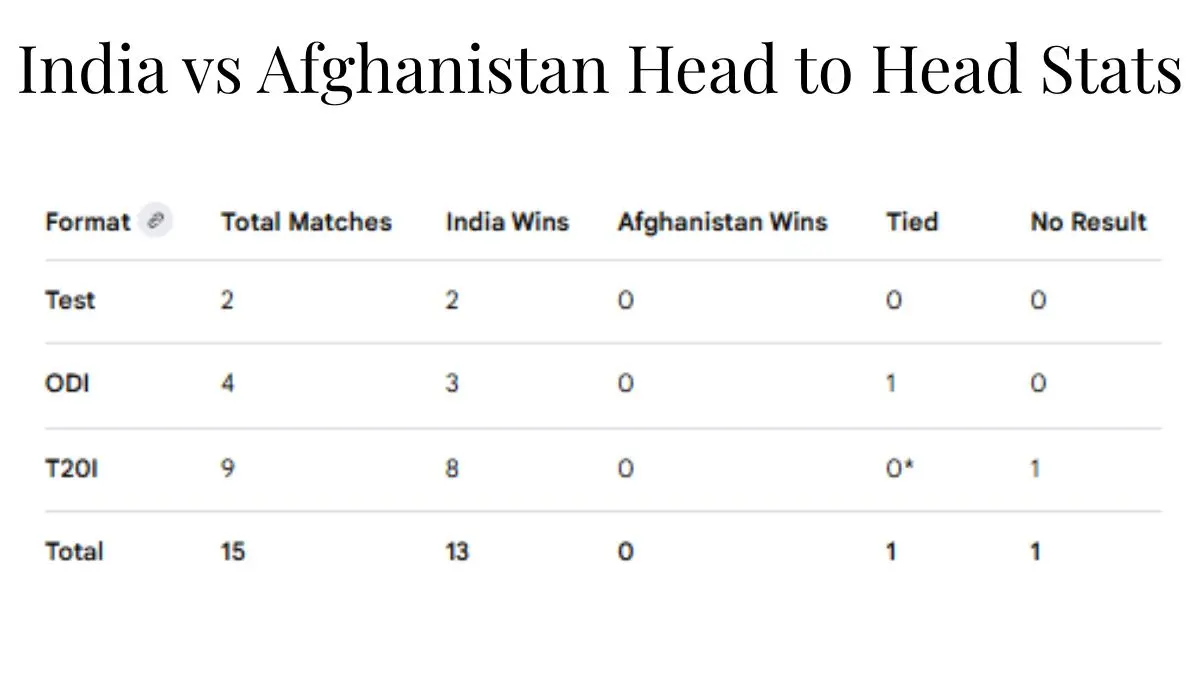
India vs Afghanistan Head-to-Head Stats
Format | Total Matches | India Wins | Afghanistan Wins | Tied | No Result |
Test | 2 | 2 | 0 | 0 | 0 |
ODI | 4 | 3 | 0 | 1 | 0 |
T20I | 9 | 8 | 0 | 0* | 1 |
Total | 15 | 13 | 0 | 1 | 1 |
The Big Picture: Head-to-Head Summary Across All Formats
The aggregate numbers are stark. Across all formats combined, the two nations have met fifteen times in completed international matches. The winning side has taken thirteen of those encounters. Afghanistan’s win column reads zero. There has been one tied match and one no result, meaning Afghanistan has never beaten India across Test cricket, ODI cricket, or T20I cricket.
Breaking this down by format reveals the scope of the dominance:
In Test cricket, two matches have been played. Both were won by India. Afghanistan has not managed a single Test victory in either encounter, and there have been no tied Tests, no rain-affected results — simply two comprehensive Indian wins.
In One-Day Internationals, four matches have been played. India has won three. There has been one tied match — a historic result in itself. Crucially, however, Afghanistan’s win column again reads zero. The solitary tied result remains the closest Afghanistan has come to breaking through.
In Twenty20 Internationals, nine matches have been played — the most encounters between these two nations in any single format. India has won eight of them. One match produced no result. Once again, Afghanistan has not managed to win a single T20I against India across nine attempts.
The cumulative picture is, therefore, one of complete and total statistical control. Thirteen victories from fifteen completed encounters, no defeats, one tie, one no result. These numbers, viewed in isolation from the actual cricket, would appear implausible — but the match-by-match breakdown confirms that this dominance is not a statistical anomaly. It is a consistent, format-agnostic pattern.
Test Cricket: Two Matches, Two Innings Victories
Test cricket is the oldest and most demanding format of the game, and the Test record between these two sides is as one-sided as any in the sport. Two Tests played. Two Tests won by India — and not merely won, but won by an innings in both instances.
Test 1: June 2018, Bengaluru
The first-ever Test match between these two sides was played in Bengaluru in June 2018, and it set the tone for everything that would follow. India won by an innings and 262 runs — a margin of victory that is difficult to overstate. Afghanistan, in their maiden Test outing against India, were bowled out for 109 in their first innings and 103 in their follow-on innings. The combined total across both Afghanistan innings was 212 runs. India, by contrast, posted 474 runs in their single innings before enforcing the follow-on.
The individual performances from India in this match were remarkable. Shikhar Dhawan was a standout batter, posting a score of 107. Murali Vijay contributed 105, meaning two Indian openers both scored centuries in the same innings. With the ball, R. Ashwin was devastating, finishing with figures of 4 for 27 — a miserly return that reflected how poorly Afghanistan handled the conditions.
For Afghanistan, the Bengaluru Test was a lesson in the gulf that existed between the two sides at that point in time. Being bowled out for 109 and 103 — totals that a county second XI might manage on a bad day — illustrated that against top-quality Indian bowling on a subcontinental pitch, Afghanistan’s batting had very little to offer.
Test 2: June 6-8, 2026, New Chandigarh (The Most Recent Encounter)
If the Bengaluru Test was a statement, the second Test — played in New Chandigarh in June 2026, just days before the time of writing — was an emphatic reaffirmation. India posted 564 for 8 declared, their highest team score in this particular contest. Afghanistan were bowled out for 152 in their first innings and 103 in their follow-on innings, a combined total of 255 — not enough to avoid an innings defeat against 564.
India won by an innings and 300 runs. That margin — an innings and 300 runs — was described in the source data as India’s biggest-ever Test match win by innings and runs. It is an extraordinary landmark, and it came, fittingly, against Afghanistan.
The match produced a standout individual story: Manav Suthar, a debutant, was named Player of the Match after returning figures of 6 wickets for 33 runs in his first innings and taking 1 wicket in the second. A debutant winning Player of the Match in a Test match is rare enough; doing so with bowling figures of that quality makes it even more remarkable.
Captain Shubman Gill anchored India’s mammoth first innings total with a score of 126 runs, providing the foundation upon which India’s massive 564 for 8 declared was built.
The statistical summary for Test cricket alone paints a vivid portrait: India Wins — 2. Afghanistan Wins — 0. India’s highest team score: 564 for 8 declared at New Chandigarh in 2026. Afghanistan’s lowest team score: 103 all out at Bengaluru in 2018. The recent result: a win by an innings and 300 runs. These are the facts of Test cricket between these two nations, and they leave no room for ambiguity.
One-Day International Cricket: The ODI Record and a Historic Tie
Four ODIs have been played between these two nations across two international tournaments — the Asia Cup and the ICC World Cup. India has won three. One match, played at the 2018 Asia Cup, ended in a tie. Afghanistan has never won an ODI against India.
The Matches in Chronological Order
February 25, 2014 — Asia Cup The earliest ODI on record between these two nations was an Asia Cup encounter in February 2014, which India won by 8 wickets. An 8-wicket victory is a highly dominant margin in ODI cricket, indicating that Afghanistan’s batting total was either modest or India’s chase was executed with considerable authority.
September 25, 2018 — Asia Cup, Dubai: The Historic Tie. The most dramatic match in the entire head-to-head record is undoubtedly the Asia Cup ODI at Dubai in September 2018. Both teams scored exactly 252 runs — a tie. This remains the only match in the entire bilateral history where Afghanistan was not on the losing side. The statistical note describes it as a “historic tie,” and the symmetry of both sides reaching 252 is a genuinely remarkable coincidence. It stands as Afghanistan’s single best result against India across any format: an occasion when the contest was perfectly balanced.
June 22, 2019 — ICC World Cup When the two sides met at the 2019 ICC World Cup, India won by 11 runs. An 11-run margin in a high-stakes World Cup encounter is relatively narrow in ODI terms, though it should be noted that India still won. This was not a tie or a last-over thriller that ended in Afghanistan’s favour — it was an Indian victory, however slim.
October 11, 2023 — ICC World Cup The most recent ODI between the two sides was a 2023 ICC World Cup encounter, which India won by 8 wickets. Like the 2014 Asia Cup match, this was an emphatic result by margin, with India barely breaking a sweat in pursuit of whatever total Afghanistan had set.
In terms of notable individual performances in ODI cricket, the data highlights several key names. For India, Rohit Sharma scored 131 off 84 balls at Delhi in 2023 — a blistering knock that underscores the quality India has brought to these encounters. Mohammed Shami was the standout Indian bowler, taking 4 wickets for 40 runs at Southampton in 2019. For Afghanistan, Mohammad Nabi scored 84 at Dubai in 2018, and Mohammad Shahzad posted 124 at Mirpur in 2014 — two innings that represent Afghanistan’s best individual batting contributions across the ODI record.
The record also notes something significant for the near future: three ODIs between these sides are upcoming, scheduled for June 13, 17, and 20, 2026, at Dharamsala, Lucknow, and Chennai, respectively. This means the ODI chapter of this head-to-head rivalry is very much live and current.
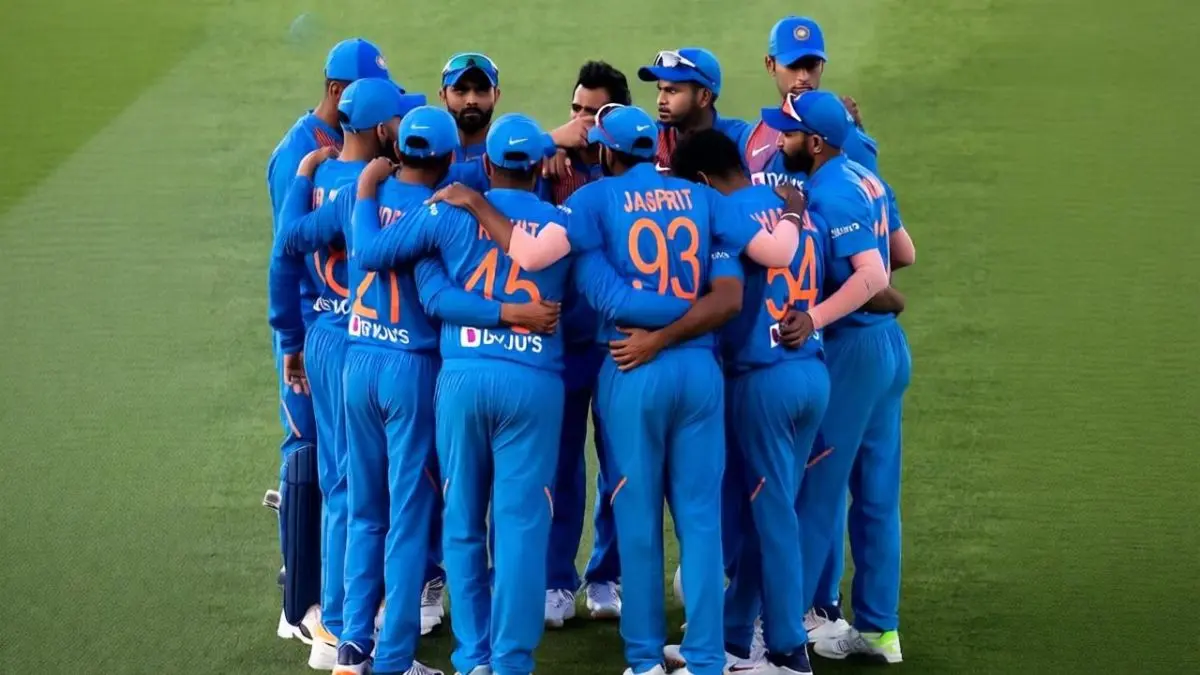
Twenty20 International Cricket: Nine Matches, Eight Wins
With nine T20I encounters played, this is the format in which these two sides have met most frequently. India’s dominance is, if anything, even more pronounced in statistical terms here: eight wins from nine matches, with one no result. Afghanistan has not won a single T20I against India.
The Numbers in the T20I Format
India’s win rate in T20Is against Afghanistan stands at 88.9% from completed matches — effectively nine attempts, one no result, eight victories. The singular no result represents the only occasion across nine encounters where the match did not produce an outright Indian victory or, as in the ODI record, a tie.
The highest team scores in T20I cricket between these sides are notable. India reached 212 for 4 at some point in this series of encounters. Afghanistan, by comparison, posted 212 for 6 in Bengaluru in 2024 — their joint-highest T20I score in these matches, and one that reflects a degree of batting capability at the shortest format, even if it was not enough to win.
The largest margin of victory India recorded in T20I cricket against Afghanistan was 101 runs, achieved at the 2022 Asia Cup in Dubai. A 101-run margin in T20I cricket is enormous — it suggests that India posted a very large total and then skittled Afghanistan out for a small one, or that India bowled out Afghanistan for a tiny score and knocked off the target with minimal effort. Either way, a three-figure winning margin in T20I cricket is a statement of dominance.
There is an asterisk worth noting in the T20I record. One match, played on January 17, 2024, was officially recorded as a tie — but with an important clarification. The game was decided via a double Super Over, which India won. A Super Over is T20 cricket’s equivalent of a penalty shootout: it is a tie-breaker mechanism, not part of the match itself. The result was therefore technically logged as a tied match in the raw statistical ledger, but in competitive terms, India ultimately prevailed. This means that even in the one T20I encounter closest to an Afghan victory, India still won the deciding Super Over. The pattern holds.
The T20I Record in Context
Nine T20I encounters without a single Afghan win is a notable statistical achievement for India’s part, and reflects a combination of factors: India’s depth of T20I talent, their experience at the highest level, and, often, the advantage of playing on familiar subcontinental conditions. That said, the fact that Afghanistan posted 212 for 6 in Bengaluru in 2024 — a genuinely competitive total on any ground — shows that this is not a contest between a professional side and complete novices. Afghanistan can bat. They can compete. But against India, they have consistently fallen short.
The Broader Narrative: Context and Significance
The numbers tell one story; the context provides another layer. Afghanistan’s journey to the top tier of international cricket is, by any measure, one of the great stories in the sport’s recent history. A country that has experienced extraordinary upheaval, with cricket emerging as both a source of national pride and a vehicle for talent development, Afghanistan has risen through the associate ranks to compete in all three formats against the world’s best teams.
Their record against India must be understood within that broader journey. They have beaten other major Test nations. They are a competitive side in T20I cricket globally. Their presence at World Cups has become expected rather than surprising. Yet against this particular opponent — India, the world’s most powerful cricket economy and a nation with deep structural advantages in talent, infrastructure, and international experience — Afghanistan has been unable to translate its growth into competitive results.
The ODI tie in Dubai in 2018 was perhaps the moment that most clearly illustrated the potential. Scoring exactly 252 in an international match, forcing a tie against India in a tournament contest, was an achievement that resonated far beyond the statistics. It suggested that on a given day, Afghanistan could match its opponents run for run.
But one tie in fifteen matches, surrounded by thirteen Indian victories, does not yet constitute a competitive record. It is, rather, a single data point of promise in an otherwise comprehensive ledger of Indian dominance.
Individual Highlights That Define the Series
Certain individual performances stand out across the statistical record as defining moments of this rivalry.
In Test cricket, R. Ashwin’s bowling at Bengaluru in 2018 — four wickets for 27 runs — remains a demonstration of how to exploit subcontinental conditions against technically limited batting. In 2026, the debutant Manav Suthar’s six wickets on debut are the most recent addition to this list, and arguably the most striking: taking six wickets in your first-ever Test innings, against any opponent, requires both skill and composure.
Shikhar Dhawan’s century at Bengaluru and Shubman Gill’s 126 at New Chandigarh bookend the two Tests with quality Indian batting, while Murali Vijay’s century alongside Dhawan in 2018 represents the kind of opening partnership dominance that set the tone for what followed.
In ODIs, Rohit Sharma’s 131 off 84 balls stands as the single most explosive individual batting performance in the data set, a score that was presumably posted at the 2023 World Cup. Mohammad Shahzad’s 124 for Afghanistan in 2014 remains their highest individual ODI score against India — a reminder that, on one day, their batting can compete.
In T20Is, the back-and-forth of a double Super Over in January 2024 is the closest thing to genuine drama that the T20I record has produced. That it ended with India winning the decider merely adds to the relentlessness of their dominance.
Looking Ahead: The 2026 ODI Series
The three upcoming ODIs — at Dharamsala, Lucknow, and Chennai on June 13, 17, and 20, 2026 — represent the next chapter of this story. With the historical record reading 13-0 in completed matches, the question is not simply whether India will win these matches, but whether Afghanistan has developed sufficiently over time to alter the dynamic.
The New Chandigarh Test in June 2026 — India’s biggest-ever innings victory by runs — does not suggest a side that is narrowing the gap. But the ODI format has historically been slightly more competitive: the 11-run World Cup victory in 2019 and the 2018 Asia Cup tie both show that in the fifty-over game, Afghanistan can be competitive for at least large portions of a match.
Three ODIs across three different Indian cities — the hilly conditions of Dharamsala, the more traditional settings of Lucknow and Chennai — will provide different challenges and conditions. Whether Afghanistan can secure their first-ever win against India will be one of the talking points as these matches approach.
Conclusion: A Record Without Precedent
Thirteen wins, zero losses, one tie, one no result. Fifteen international encounters. Three formats. Eight years of bilateral history, from Bengaluru in 2018 to New Chandigarh in 2026. India’s record against Afghanistan is, in the context of head-to-head bilateral records in international cricket, one of the most complete examples of sustained dominance in the modern era.
It is not a record built on luck or circumstance. Both Test matches were won by an innings — the most comprehensive possible margin in five-day cricket. The 2023 World Cup ODI was won by 8 wickets. Eight from nine T20Is ended in Indian victories, and the ninth — the tie — was resolved in India’s favour via Super Over.
For Afghanistan, the record is a challenge to be overcome rather than a reason for despair. Their very presence on this stage, playing Test cricket, qualifying for World Cups, and producing individual performances of genuine quality, is itself a triumph. The tie of 2018 proved they can match India for stretches of a match. The 212 for 6 in Bengaluru in 2024 showed that they can construct competitive totals.
But the ledger, as it stands, belongs entirely to one side. Until Afghanistan registers that first win — in a T20I, an ODI, or ideally a Test match — the statistical record of this head-to-head will remain not merely a record of India’s excellence, but one of the most lopsided bilateral records in the history of international cricket.
Footnotes
References
External links