Ker vs Gcc
In the annals of domestic cricket, there are matches that are won, matches that are lost, and then there are rare contests that transcend the final scoreline. The recently concluded multi-day clash at the Narendra Modi Stadium in Ahmedabad belongs to this last, most exalted category. When the last ball was bowled, and the weary combatants shook hands, the scoreboard revealed a result that defies the ordinary grammar of cricket: a hard-fought draw. But calling it merely a draw misses the point entirely. For the Kerala cricket team, this stalemate is a victory of historic proportions—a triumph carved not in runs alone, but in resilience, nerve, and a razor-thin mathematical margin.
After 74 long years, Kerala has booked a spot in the final of India’s premier domestic first-class competition. The gateway to that promised land was not a roaring victory by an innings or a thumping ten-wicket win. Instead, it was secured through the slimmest of possible leads: a two-run advantage in the first innings. This article delves deep into the image provided, unpacking every ball, every partnership, and every strategic declaration that led to this momentous occasion.
Match Overview
Detail | Information |
Match | Kerala (KER) vs Gujarat (GUJ) |
Tournament | Ranji Trophy 2024–25 (Semi-Final) |
Venue | Narendra Modi Stadium, Ahmedabad |
Result | Match Drawn (Kerala qualified for the final based on a 2-run first-innings lead) |
Player of the Match | Mohammed Azharuddeen (Kerala) |
Innings Scoreboard
Team / Innings | Score | Overs | Top Batsmen |
Kerala 1st Innings | 457 All Out | 187 | Mohammed Azharuddeen (177), Sachin Baby (69) |
Gujarat 1st Innings | 455 All Out | 174.4 | Priyank Panchal (148), Jaymeet Patel (79) |
Kerala 2nd Innings | 114/4 Declared | 46 | Jalaj Saxena (37*), Rohan Kunnummal (32) |
Key Bowling Performances
Team | Bowler | Wickets/Runs |
Kerala | Jalaj Saxena | 4/149 |
Kerala | Aditya Sarwate | 4/111 |
Gujarat | Arzan Nagwaswalla | 3/81 (1st Innings) |
The Colosseum of Cricket: The Narendra Modi Stadium
The stage itself added a layer of gravitas to the proceedings. The Narendra Modi Stadium, the largest cricket stadium in the world, played host to this multi-day drama. Its vast expanses and imposing stands have witnessed many high-voltage encounters, but few with such a slow-burning, tension-filled narrative. The pitch, true to its reputation, offered a fair contest between bat and ball over long periods. This demanded patience, discipline, and an almost old-world temperament from the players. It was a surface where sessions, not overs, became the units of measurement. On this pitch, the value of a single run could swing from trivial to monumental. By the match’s end, every run from the first innings carried the weight of history.
The First Innings: Kerala’s Marathon of Grit (457 All Out, 187 Overs)
Kerala won the toss and elected to bat first—a decision that would prove to be the bedrock of their historic achievement. Their first innings was not a blaze of glory but a slow, inexorable accumulation of runs over a staggering 187 overs. In an era of white-ball pyrotechnics, this was a testament to old-fashioned Test-match endurance.
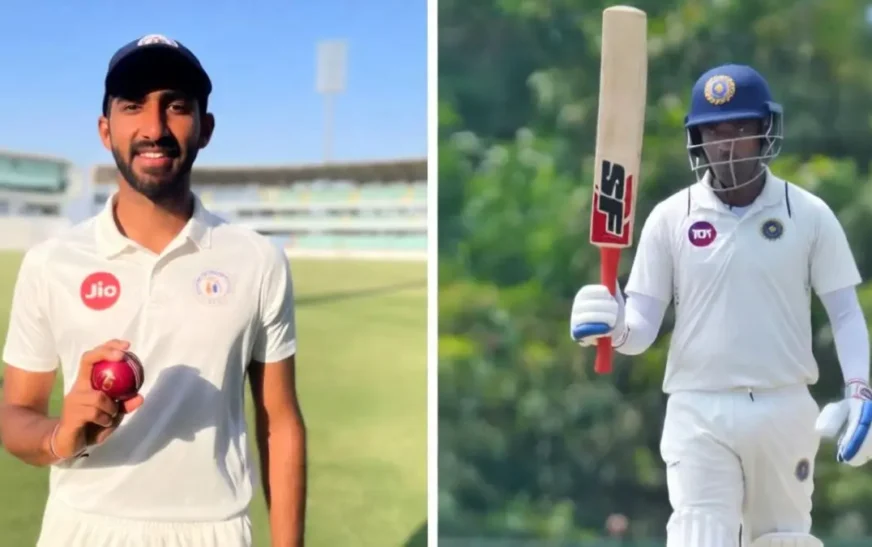
The cornerstone of this monumental total was the wicketkeeper-batsman Mohammed Azharuddeen, who played the innings of his life. His score of 177 was not a whirlwind; it was a marathon. Over several sessions, Azharuddeen anchored the innings with the patience of a monk and the concentration of a grandmaster. He watched the new ball swing, saw off the hostile spells from Gujarat’s pace attack, and then gradually expanded his range. Each run was a brick in a fortress that Kerala was building. His 177 was a study in classical first-class batting—leaving balls outside off, defending with a straight bat, and punishing the loose deliveries with precision. It was an innings that drained the Gujarat bowlers not just physically but mentally, as they returned to their marks over 187 overs, knowing that a breakthrough was a rare luxury.
Supporting Azharuddeen was the experienced Sachin Baby, who contributed a valuable 69. Baby’s role was crucial. While Azharuddeen was the sheet anchor, Baby provided the necessary momentum at various junctures, rotating the strike and ensuring that the scoreboard never stagnated. Their partnership formed the spine of the innings, allowing Kerala to weather the inevitable periods of pressure that Gujarat applied.
At the other end, the lower order chipped in where necessary, but the headline remained the sheer volume of deliveries faced. To bat 187 overs in a single innings is an act of collective will. It tells the story of a team that understood the assignment: post a total so substantial that it would psychologically burden the opposition and create a cushion, no matter how small, for the remainder of the match. When the ninth wicket fell, and Kerala was finally all out for 457, they had done their job. They had set a formidable, if not insurmountable, target.

Gujarat’s Response: A Mirror Image (455 All Out, 174.4 Overs)
If Kerala’s first innings was a tale of patience, Gujarat’s reply was a near-perfect mirror. Chasing 458 for a first-innings lead, the home team responded with an equally epic 455 all out in 174.4 overs. The symmetry of the totals—a mere two runs separating the sides after more than 360 overs of cricket—is the kind of statistical anomaly that makes cricket such a uniquely beautiful and cruel sport.
Gujarat’s resistance was led by their own batting stalwart, Priyank Panchal. His knock of 148 was a captain’s innings in every sense of the word. Panchal, no stranger to big runs in domestic cricket, played with an authority that suggested he was determined to snatch the psychological advantage away from Kerala. He watched the ball like a hawk, drove with elegance, and pulled with authority. His hundred was a statement of intent: Gujarat would not go down without a fight.
He found a capable ally in Jaymeet Patel, who scored 79. Patel’s innings was the perfect foil to Panchal’s aggression. While Panchal dominated the strike and scored at a brisk pace, Patel provided solidity at the other end. The duo stitched together a partnership that brought Gujarat perilously close to Kerala’s total, and for a while, it seemed as though the home side would take a slender lead into the second half of the match. The crowd at the Narendra Modi Stadium, though not explicitly mentioned in the image, must have sensed the tide turning.
The Bowling Battle: Saxena and Sarwate Shine
However, a match of this magnitude is never decided by batsmen alone. Kerala’s bowling attack, led by the wily duo of Jalaj Saxena and Aditya Sarwate, had other plans. The image highlights their exceptional figures: Jalaj Saxena took 4/149, while Aditya Sarwate took 4/111. These numbers, viewed in isolation, might seem expensive. But in the context of an innings that lasted nearly 175 overs, they are nothing short of heroic.
Spinners often dominate in the later stages of multi-day matches, but here, both Saxena and Sarwate were tasked with breaking partnerships on a surface that still favored batting. Their four-wicket hauls were not about magical deliveries alone; they were about discipline, subtle variations in pace, and an unerring ability to build pressure over long spells. Saxena, with his off-breaks, bowled with a loop that tempted the batsmen into false shots. Sarwate, the left-arm spinner, provided the contrast, angling the ball across the right-handers and bringing the edges into play.
Together, they strangled Gujarat’s middle and lower order. Just when Panchal and Patel seemed to be steering Gujarat towards safety, Saxena or Sarwate would strike. The fall of wickets was gradual but relentless. And in the end, their collective effort produced the most dramatic of outcomes: Gujarat was bowled out for 455, just two runs short of Kerala’s first-innings total.
Let that sink in. After 174.4 overs of batting, after scores of 148 and 79, after hours of toil in the Ahmedabad heat, Gujarat finished two runs behind. In any other context, a two-run lead is a statistical quirk. But here, it was the key that unlocked 74 years of history. By securing that tiny 2-run lead, Kerala gained the ultimate psychological and tactical advantage: the first-innings lead.
The Second Innings: A Calculated Declaration (114/4 Declared, 46 Overs)
With a first-innings lead—however slender—Kerala now had the luxury of setting the agenda. The image reveals that in their second innings, Kerala adopted a completely different approach. Gone was the blockathon of the first innings. In its place was urgency and calculated aggression. Kerala scored 114 runs for the loss of 4 wickets in just 46 overs before declaring.
The declaration is a fascinating strategic maneuver. By not batting indefinitely, Kerala was making a statement: we are not interested in a defensive draw. We are going to give ourselves time to bowl Gujarat out. But why declare at only 114/4? The answer lies in the mathematics of the match situation. Kerala already had a two-run lead from the first innings. By adding 114 runs and then declaring, they effectively set Gujarat a target of 116 runs to win in the fourth innings, but crucially, they left themselves enough overs to bowl the opposition out.
The key performers in this brisk second innings were Jalaj Saxena, who remained not out on 37, and opening batter Rohan Kunnummal, who scored 32. Saxena, already the hero with the ball, played a cameo of intent. His 37 not out would have come at a healthy strike rate, ensuring that the declaration was made with plenty of time remaining in the day’s play. Kunnummal, at the top of the order, provided a rapid start, pushing the scoring along and putting the Gujarat bowlers back on their heels.
The declaration at 114/4 was a masterstroke—it was neither too defensive (which would have invited a boring draw) nor too reckless (which could have resulted in a sudden collapse). It was the Goldilocks decision: just right.
The Final Verdict: A Hard-Fought Draw and a Historic Final
So, after all this—the 177, the 148, the 4/111, the 4/149, the calculated declaration—why does the image say the match ended in a hard-fought draw? Because in the time remaining, Kerala’s bowlers could not take the final ten wickets, and Gujarat’s batters chose not to risk chasing an unlikely 116. In a multi-day match, a draw is often an anti-climax. But not here.
Under the rules of first-class cricket, the winner of a multi-day knockout match is determined by either an outright victory (bowling the opposition out twice) or, if time runs out, by the first-innings lead. Kerala had that lead. Two runs. That was enough.
Thus, the match ended as a draw on the scoreboard, but as a win for Kerala in the record books. By securing that tiny 2-run lead in the first innings, Kerala scripted history by booking their spot in the final for the first time in 74 years. Seventy-four years is not a statistic; it is a generational curse. It is decades of near-misses, of heartbreaks, of seasons that promised much but delivered little. For the players in the Kerala dressing room, many of whom had grown up hearing tales of past failures, the moment the Gujarat ninth wicket fell, and the first-innings lead was confirmed, must have felt like an exorcism.
The Hero of the Hour: Mohammed Azharuddeen
No recap of this match would be complete without honoring the man who made it all possible. Wicketkeeper-batsman Mohammed Azharuddeen was named Player of the Match for his marathon 177-run knock in the first innings. In a match defined by margins of two runs, his contribution of 177 stands as a colossus. Without that innings, Kerala would have been lucky to reach 300. Without that inning, the two-run lead would have been a two-run deficit.
Azharuddeen’s role as a wicketkeeper-batsman adds another layer of difficulty. The physical toll of keeping wickets for over 174 overs in Gujarat’s first innings, and then batting for nearly two full days in the first innings, is almost incomprehensible. His 177 was not just a display of skill; it was a display of endurance, of mental fortitude, and of an unshakeable belief that this time, history would be different.
Strategic Significance: The Blueprint of Belief
The strategic significance of this match cannot be overstated. Kerala’s game plan was a masterclass in long-format tactics. First, bat long and deep—187 overs is a statement of survival. Second, bowl with relentless discipline, even when the opposition’s top order is scoring runs—Saxena and Sarwate’s four-wicket hauls prove that patience in bowling is as vital as patience in batting. Third, use the declaration aggressively—114/4 in 46 overs shows that Kerala was playing to win, not to survive. And fourth, trust in the laws of the game—the first-innings lead, no matter how small, is a legitimate and glorious way to advance.
For Gujarat, the heartbreak will linger. To score 455 in reply to 457 and still lose the semifinal (or equivalent knockout) on the first-innings rule is a cruel fate. Their bowlers, led by Arzan Nagwaswalla, who took 3/81 in the first innings, bowled their hearts out. Panchal and Patel batted with immense courage. But in sport, fine margins separate heroes from tragic figures. Two runs. That is the distance between going home and going to the final.
Conclusion: A New Dawn for Kerala Cricket
As the players walked off the Narendra Modi Stadium, the draw on the scoreboard belied the earthquake that had just taken place in the Kerala cricketing landscape. For 74 years, the final had been a distant, almost mythical dream. Now, it is a reality.
This match will be remembered not for its sixes or its spectacular catches, but for its attritional warfare, its tactical nuance, and its breathtakingly close finish. It will be remembered as the match where Mohammed Azharuddeen became a legend, where Jalaj Saxena and Aditya Sarwate spun a web of precision, and where a team from the southern coast of India proved that in cricket, you don’t always need to win the battle to win the war. Sometimes, all you need is a two-run lead, 187 overs of grit in the first innings, and 74 years of pent-up desire.