Afghanistan Tour of India 2026 T20 Series Pitch Reports, Full Squad
Delhi’s Arun Jaitley Stadium is set to make history this September. For the first time on Indian soil, India and Afghanistan will contest a full bilateral T20I series, with the venerable ground in the national capital hosting all three matches on September 13, 15 and 17, 2026. Every fixture carries a 7:30 PM start, ensuring the floodlights, the dew, and a packed Delhi crowd will all have a say in how the series unfolds.
The timing is no accident. The series lands barely a week before the men’s cricket competition at the 2026 Asian Games in Japan gets underway, turning this into far more than a routine bilateral assignment — it is the last meaningful hit-out both sides get before a continental title is on the line. For India, it is also the continuation of a T20I rebuild under a brand-new captain. For Afghanistan, it is the first time they will appear on Indian soil as the “home” side in a bilateral series against India, a symbolic landmark for a team that has spent years playing its “home” fixtures away from home.
The Schedule
| Match | Date | Venue | Time |
|---|---|---|---|
| 1st T20I | September 13, 2026 | Arun Jaitley Stadium, New Delhi | 7:30 PM |
| 2nd T20I | September 15, 2026 | Arun Jaitley Stadium, New Delhi | 7:30 PM |
| 3rd T20I | September 17, 2026 | Arun Jaitley Stadium, New Delhi | 7:30 PM |
Keeping all three matches at a single venue is a departure from how India has hosted white-ball series in recent years, when fixtures are typically spread across two or three cities to give more fans access to live cricket. The decision to centralise this series in Delhi appears to be driven by logistics — a tight turnaround before the Asian Games leaves little room for the travel and pitch-preparation overheads of a multi-city tour. It does mean, however, that both squads will get to know the surface intimately across the series, and any tactical adjustments a team makes after Match 1 can be applied with precision by Match 3.
Because the Asian Games squad announcements for both India and Afghanistan came before this series was finalised, selectors on both sides have effectively used this window as a dress rehearsal. Expect heavy overlap between the T20I squads picked for this series and the sides that will travel to Japan for the Games.
Why This Series Matters
Afghanistan’s cricketing story over the last decade has been shaped as much by circumstance as by talent. Security and infrastructure limitations at home have forced the Afghanistan Cricket Board to stage its “home” internationals in India — largely in Greater Noida and Dehradun — and in the United Arab Emirates. What makes this series different is that, for the first time, India and Afghanistan are meeting as designated hosts and visitors on a full-sized, marquee Indian venue, with Delhi’s historic ground standing in as Afghanistan’s home turf. It’s a quiet but meaningful moment in the two boards’ cricketing relationship, built on years of the BCCI extending support to the ACB.
On the field, the head-to-head picture still tilts heavily toward India. The two sides have met nine times in T20Is, with India winning eight and one match ending without a result — a run that includes a Super Over classic in Bengaluru in January 2024, when both teams finished locked together on 212. Afghanistan will be desperate to close that gap, particularly with confidence in the format needing a rebuild after their group-stage exit at the 2026 T20 World Cup.
Both teams, in fact, arrive at this series carrying scars from a difficult 2026. India, under new T20I captain Shreyas Iyer, endured a rocky tour of Ireland and a 4-0 series defeat in England, a chastening start to the post-Suryakumar Yadav era. Afghanistan’s own T20 World Cup campaign ended early, prompting the Afghanistan Cricket Board to remove Rashid Khan as T20I captain and hand the leadership to opening batter Ibrahim Zadran, with a new head coach also brought in to reset the team’s white-ball direction. In other words, this is a series between two sides mid-transition, each using the Delhi assignment to find its feet before a tournament that actually carries a medal.
Pitch Report: What to Expect at Arun Jaitley Stadium
Few venues in India carry as much cricketing history as the Delhi ground formerly known as Feroz Shah Kotla. First staging a Test in 1948 and renamed in 2019 in honour of former BCCI stalwart and Union minister Arun Jaitley, the stadium has evolved over the decades from a spin-friendly relic into one of the more balanced, batter-friendly surfaces on the Indian white-ball circuit.
The historical numbers tell a clear story. Delhi has hosted seven men’s T20Is to date, with the team batting second winning four of them against three for the side batting first — a modest but real lean toward chasing. The average first-innings score in T20Is at the venue sits in the 164-170 range, while the highest total recorded here is 212 for 3, posted by South Africa in a 2022 run-chase against India that remains the ground’s benchmark T20I score. At the other end, India were bowled out for 120 against New Zealand, a reminder that the surface can turn testing if the ball seams around under lights or if the required rate spirals out of control in a chase.
Arun Jaitley Stadium Pitch Report
| Feature | English | |
| Pitch Behavior | Traditionally known as a slow and low track, modern pitches have been relaid to offer more true bounce, making it a high-scoring ground for white-ball cricket. | |
| Batting or Bowling | Heavily favors batters once they settle. The small boundaries and fast outfield make stroke-making much easier. | |
| Spin vs Pace | Historically friendly to spinners as the pitch wears out and slows down in the middle overs, offering grip and turn. | |
| Chasing Preference | Captains winning the toss generally prefer to bowl first to assess the pitch, though dew can also play a factor in night games. | |
| Average Scores | T20/IPL: 175 – 190+ runs ODI: 260 – 300+ runs |
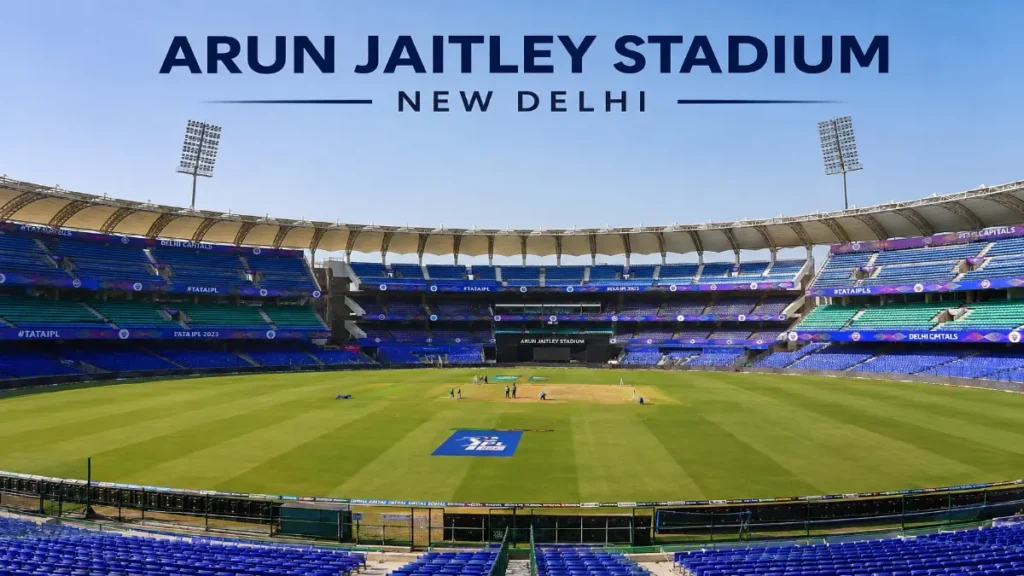
Broadly, this is regarded as a good batting pitch that gets progressively easier as a match wears on. The new ball tends to offer pace bowlers a little swing and seam movement in the opening overs — historical figures like Chris Jordan’s 4 for 28 for England against Sri Lanka in a T20I here are proof that early wickets are on offer for disciplined seam bowling. Once the shine goes, though, the pitch flattens out, and stroke play becomes far easier: the ball comes on nicely, the outfield is quick, and the square boundaries at this ground are on the shorter side, which rewards batters who can clear the ropes with a flat trajectory rather than a towering hit.
Spin is not irrelevant, either. As the surface dries through the middle overs, there is enough purchase for quality spinners to extract turn and control the scoring rate, even if the assistance is rarely as pronounced as at more traditional turning tracks elsewhere in India. Economy rates for spin bowlers at this venue tend to compare favourably with pace, even though seamers have historically taken more wickets in the IPL era — a sign that canny spin bowling, rather than raw pace, is often the difference-maker in the tightest passages of a Delhi T20I.
The other major variable, as at most Indian venues hosting night matches, is dew. With all three fixtures starting at 7:30 PM, dew is likely to settle in by the second innings, making the ball harder to grip for bowlers and easier to strike for batters. That dynamic has historically nudged captains toward bowling first after winning the toss, since defending a total under heavy dew becomes considerably harder than chasing one. Expect toss decisions across the series to be influenced strongly by this factor, along with overnight and matchday humidity readings closer to September 13.
Put together, sides walking out in Delhi this September should expect a surface that starts with some help for the new-ball bowlers, flattens into a genuine stroke-maker’s paradise through the middle overs, offers control (if not big turn) to spinners, and tilts toward the chasing team once the dew sets in. A par score in the 175-190 range looks a reasonable par, with anything past 195 likely to be a match-winning total unless conditions are unusually bowler-friendly on a given evening.
India vs Afghanistan: Squad Picture
| Player Role | India (Expected Players) | Afghanistan (Expected Players) |
| Batters / Top Order | Shubman Gill, Rohit Sharma, Yashasvi Jaiswal, Virat Kohli, Shreyas Iyer | Ibrahim Zadran, Sediqullah Atal, Darwish Rasooli, Rahmat Shah, Hashmatullah Shahidi |
| Wicketkeepers | KL Rahul, Ishan Kishan, Rishabh Pant | Rahmanullah Gurbaz, Ikram Alikhil |
| All-Rounders | Hardik Pandya, Washington Sundar, Nitish Kumar Reddy, Harsh Dubey | Rashid Khan, Mohammad Nabi, Azmatullah Omarzai, Nangialai Kharoti |
| Bowlers | Arshdeep Singh, Kuldeep Yadav, Prasidh Krishna, Harshit Rana, Gurnoor Brar | Fazalhaq Farooqi, Mujeeb Ur Rahman, Noor Ahmad, AM Ghazanfar, Bilal Sami |
India’s T20I setup has been through visible change in 2026. Shreyas Iyer was confirmed as the new full-time T20I captain in June, with Tilak Varma appointed his deputy, after the selectors moved on from Suryakumar Yadav following a modest T20 World Cup and a lean IPL season. That leadership axis — Iyer at the helm, Varma as vice-captain — is expected to carry through into the Afghanistan series and, by extension, into the Asian Games squad picked for Japan.
The squad India named for the preceding Ireland and England T20I assignments offers the clearest guide to who is currently in favour: Shreyas Iyer, Tilak Varma, Abhishek Sharma, Sanju Samson, Ishan Kishan, Shivam Dube, Nitish Kumar Reddy, Washington Sundar, Axar Patel, Varun Chakravarthy, Ravi Bishnoi, Harshit Rana, Arshdeep Singh, Mohammed Siraj and Prince Yadav have all featured recently, alongside teenage prodigy Vaibhav Sooryavanshi, who earned a maiden call-up on the back of an explosive IPL 2026 campaign with Rajasthan Royals. Jasprit Bumrah, rested for the England and Ireland tours, has already been named in India’s squad for the Asian Games and would be a notable boost if fit and available for the Afghanistan series as well.
Given how closely this series sits alongside the Asian Games, expect the core of India’s Delhi squad to mirror the group picked for Japan: Iyer as captain, Varma as his deputy, an opening pairing built around Abhishek Sharma and Sanju Samson (with Sooryavanshi pushing for a look-in), a middle order anchored by Shivam Dube and Nitish Kumar Reddy, and a spin-heavy bowling attack featuring Axar Patel, Washington Sundar, Varun Chakravarthy and Ravi Bishnoi, backed by a pace unit of Arshdeep Singh and Harshit Rana. An official squad announcement from the BCCI selection committee is still awaited, but the shape of the side is unlikely to differ dramatically from the pattern set across India’s 2026 T20I assignments so far.
Afghanistan
Afghanistan’s T20I unit enters this series under fresh management. Ibrahim Zadran took over the captaincy from Rashid Khan in March 2026 after Afghanistan’s early T20 World Cup exit, with Richard Pybus installed as the new head coach to oversee the team’s white-ball reset. The squad picked for Zadran’s first assignment as captain, a series against Sri Lanka, provides a strong template for who is currently trusted in the T20I setup: Zadran himself, Rahmanullah Gurbaz and Noor Rahman as wicketkeeping options, Sediqullah Atal, Darwish Rasooli and Shahidullah Kamal in the batting group, Azmatullah Omarzai and Mohammad Nabi offering all-round balance, and a spin-heavy attack featuring Rashid Khan, Noor Ahmad, Mujeeb Ur Rahman and Sharafuddin Ashraf, supported by Zia Ur Rahman Sharifi and Fareed Ahmad Malik with the new ball.
That balance — a top order built for stability, and a spin cartel that remains one of the most feared units in world cricket even without the captaincy armband on Rashid Khan — is likely to define Afghanistan’s approach in Delhi too. Given the pitch’s tendency to offer spinners control through the middle overs, Afghanistan’s attack, built around Rashid Khan, Noor Ahmad and Mujeeb Ur Rahman, could be especially well suited to squeezing India in the 7-to-15 over period, even if defending a total under Delhi’s evening dew remains a stiffer challenge. As with India, a formal squad announcement from the Afghanistan Cricket Board for this specific series was still pending as of early August 2026, with the group expected to closely resemble the personnel built around Zadran’s captaincy through the year.
The Bigger Picture
Beyond the runs, wickets and results, this series is best understood as a proving ground. Both India and Afghanistan are searching for identity in the T20 format under new leadership, both are integrating young talent alongside seasoned campaigners, and both know that whatever combinations click in Delhi will heavily influence selection for the Asian Games just days later. Add to that the symbolism of Afghanistan hosting India, on paper, at one of Indian cricket’s most storied grounds, and the three fixtures at Arun Jaitley Stadium this September carry weight well beyond a standard bilateral assignment. Fans can expect a series shaped by fast starts with the new ball, flat, high-scoring middle periods, canny spin battles, and finishes decided as much by the Delhi dew as by the players out in the middle.