Bangladesh tour of Australia 2026 Test, Pitch Reports, Full Squad
Bangladesh are set to write a new chapter in their Test history when they touch down in Australia for a landmark two-match series in August 2026 — their first red-ball assignment on Australian soil in 23 years. The tour, officially billed as the NRMA Insurance Men’s Test Series, forms an important part of the 2025–2027 ICC World Test Championship cycle, and it brings together a settled, senior Australian outfit against a Bangladesh squad still finding its feet in unfamiliar, pace-friendly conditions. With two Tests spread across nearly two weeks and two contrasting venues — one steeped in tropical humidity, the other making its Test debut altogether — this series promises to be a fascinating examination of Bangladesh’s growth as a touring side.
Series Schedule Overview
The tour runs from 13 to 26 August 2026, with both matches scheduled as traditional five-day Tests.
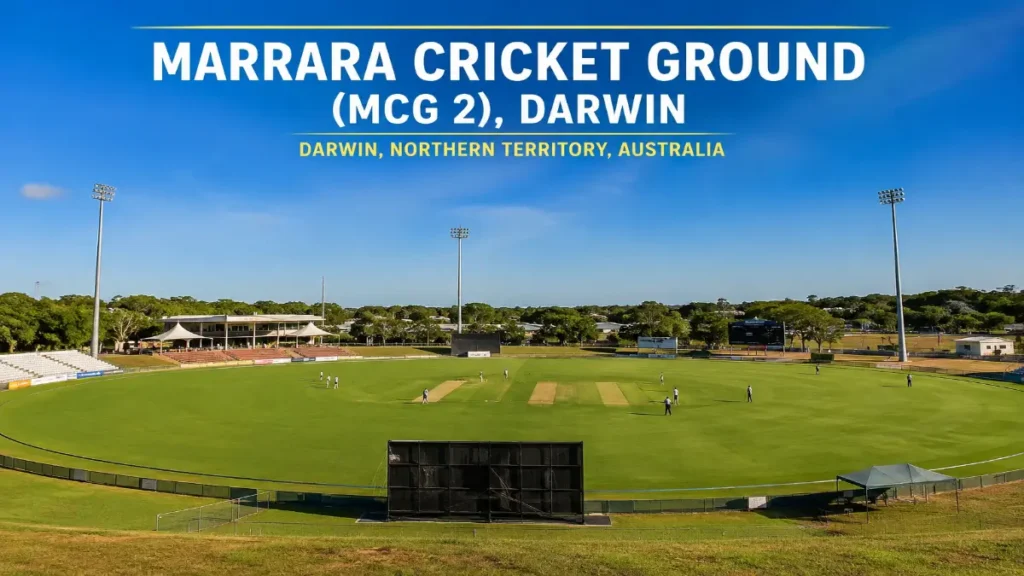
1st Test: Marrara Cricket Ground (MCG 2), Darwin Dates: August 13–17, 2026 Start Time: 6:00 AM IST
2nd Test: Great Barrier Reef Arena, South Mackay Dates: August 22–26, 2026 Start Time: 5:30 AM IST
The gap of roughly five days between the two Tests gives both squads time to travel from the tropical north down to coastal Queensland, adjust to a different pitch character, and manage the recovery of players carrying niggles — a factor that looms especially large for a Bangladesh pace attack that has been hit hard by injuries in the lead-up to the tour.
Before the series gets underway, Bangladesh were scheduled to play a three-day warm-up fixture against a Cricket Australia XI in Darwin starting August 6, giving the touring batters valuable time in the middle against Australian conditions before the real examination begins.
Marrara Cricket Ground, Darwin: Pitch and Venue Report
| Aspect | Fast Bowlers ⚡ | Spinners 🌀 | Batters 🏏 |
| Early Innings | High Support New ball generates seam movement and steep bounce. | Low Support Minimal turn early on; difficult to grip the new ball. | Challenging Need to handle extra bounce and lateral movement. |
| Middle Innings | Moderate Support Seam levels off; reverse swing can come into play if the ball wears. | Moderate Support Good drift and consistent bounce; subtle turn available. | Favorable Runs come easily once set; line and length become predictable. |
| Late Innings | Moderate Support Useful for bowling hard lengths and executing variations. | High Support Cracks and footmarks can yield sharper turn and uneven bounce. | Tricky Requires strong footwork against variable bounce. |
Tactical Strategy & Toss Recommendation
| Decision | Pros | Cons / Risks |
| Batting First | Set a dominant score; take advantage of the hard deck before the pitch deteriorates or wears down. | Must survive the threat of the fresh new ball and initial seam movement. |
| Bowling First | Exploit early morning seam, swing, and extra bounce to pick up quick early wickets. | Pitch flattens out, making it harder to restrict runs in the middle overs. |
Weather is likely to be a major storyline in itself. Darwin in August sits in the dry season, but conditions are typically hot and humid, with temperatures hovering around 32°C and humidity in the 70–80% range, along with the possibility of scattered afternoon showers. Evening dew is rare, though the high humidity can occasionally soften the surface overnight. Historically, Australia have been dominant at this venue across the limited fixtures played there, having won all six international matches staged at the ground to date, though none of the current touring squads have significant first-class experience of Marrara specifically.
For context on the ground’s cricketing pedigree: it hosted first-class fixtures as recently as 2024, when Pakistan A and Bangladesh A played out two four-day matches there, and it also featured in Sri Lanka A’s 2025 tour of Australia, giving both boards some recent familiarity with a surface that continues to evolve as Cricket Australia expands the game into the Northern Territory.
Great Barrier Reef Arena, South Mackay: A Test Venue in the Making
The second Test is a genuine historical milestone in its own right. Great Barrier Reef Arena, also known as Harrup Park, will become Australia’s 12th official Test venue, following Cricket Australia’s confirmation in February 2026 that the Queensland ground would host its first-ever Test match against Bangladesh. Located on Juliet Street in South Mackay, roughly two kilometres from the city centre, the ground is part of a wider sporting precinct and has a rich, if understated, cricketing history dating back to 1948.
Mackay’s international résumé until now has been built almost entirely around white-ball cricket. The venue hosted its first ODI back in 1992 between India and Sri Lanka — a match washed out after just two balls — and did not host another men’s ODI for 33 years, until Australia and South Africa played there in August 2025. It has also become a regular fixture on the women’s international circuit, hosting Women’s T20Is and ODIs, including matches between Australia and India in 2021 and Australia and New Zealand in 2024.
Because the ground has never hosted a Test, there is no direct historical data on how a Mackay pitch behaves across five days. However, its white-ball history offers some clues. Analysts expect the surface to carry early assistance for the seamers before settling into a more even contest, favouring batters through the middle overs but slowing down and turning as the match progresses — conditions that traditionally reward sides who win the toss and bat first. In terms of scoring patterns, ODI totals at the ground have typically sat in the 250–255 range, and the boundaries are considered medium-sized, with straight boundaries around 70–72 metres and square boundaries around 65–67 metres. For a Test debut venue, humid coastal conditions and a naturally slow-developing surface make this a ground where patience, rather than firepower, is likely to be rewarded.
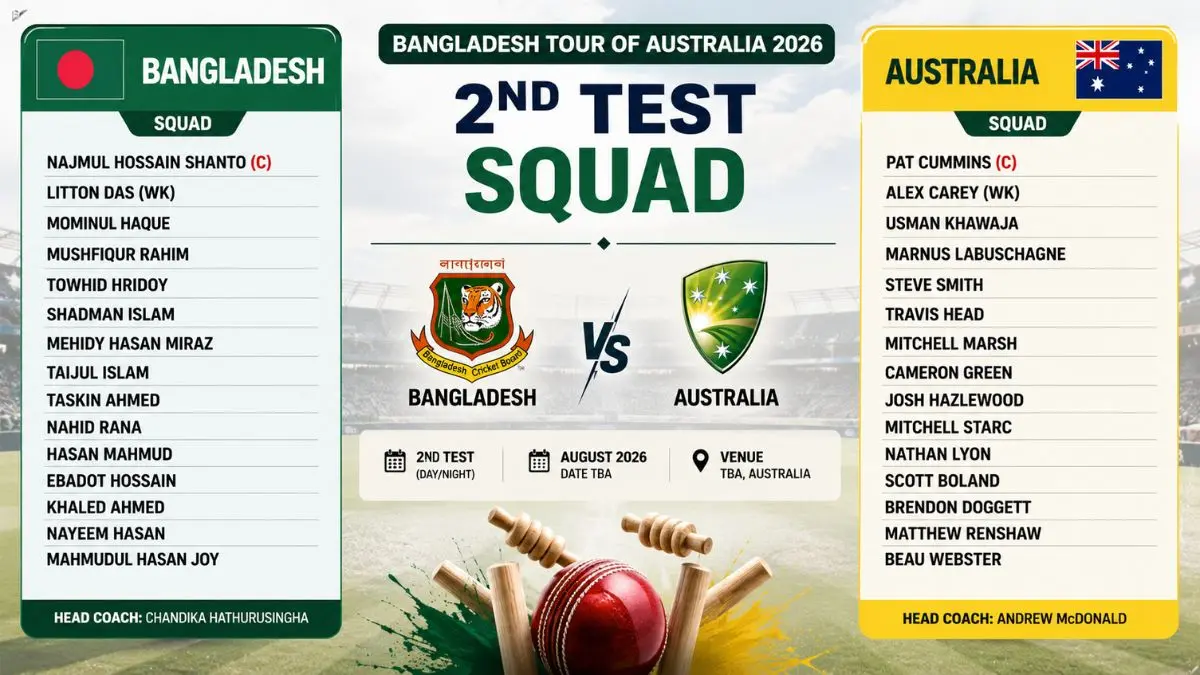
Australia Squad vs Bangladesh Squad
| Australia | Bangladesh |
| Josh Hazlewood | Mushfiqur Rahim (wk) |
| Steve Smith | Taijul Islam |
| Mitchell Starc | Taskin Ahmed |
| Nathan Lyon | Mominul Haque |
| Pat Cummins (c) | Soumya Sarkar |
| Scott Boland | Litton Das (wk) |
| Travis Head | Najmul Hossain Shanto (c) |
| Beau Webster | Mehidy Hasan Miraz |
| Alex Carey (wk) | Shadman Islam |
| Marnus Labuschagne | Jaker Ali (wk) |
| Josh Inglis (wk) | Ebadot Hossain |
| Jake Weatherald | Khaled Ahmed |
| Cameron Green | Hasan Mahmud |
| — | Amite Hasan (wk) |
| — | Tanzid Hasan |
| — | Musfik Hasan |
The headline story in the Australian camp is the return of captain Pat Cummins alongside Josh Hazlewood and Nathan Lyon, all coming back after respective injury layoffs, giving the hosts their full complement of frontline bowling experience for the series opener. With Mitchell Starc also fit and available, Australia possess four seamers — Cummins, Starc, Hazlewood and Boland — capable of exploiting any home-conditions assistance, backed by Lyon as an increasingly important spin option, particularly as pitches wear on both Darwin and Mackay surfaces.
In the batting unit, Jake Weatherald retains his opening spot following Usman Khawaja’s retirement, while the middle order remains built around the vast experience of Steve Smith, Travis Head and Marnus Labuschagne. Cameron Green and Beau Webster provide all-round balance and depth down the order, while Alex Carey and Josh Inglis give the side two capable wicketkeeping options.
Notably left out of Australia’s 13-man squad were bowlers Michael Neser, Todd Murphy and Brendan Doggett, despite each having recent good form, an indication of just how strong Australia’s seam-bowling stocks currently run.
Bangladesh
Bangladesh’s squad tells a very different story — one shaped as much by injury misfortune as by selection philosophy. The touring party, originally a 15-member group, was later boosted by the addition of a 16th player once fitness was confirmed.
The squad was confirmed by the Bangladesh Cricket Board on July 26, 2026, and its composition reflects a side dealing with a genuinely depleted pace-bowling department. Fast bowlers Nahid Rana and Shoriful Islam were both ruled out of the entire two-Test series through injury, while Mustafizur Rahman was also sidelined. That left the new-ball responsibilities to Taskin Ahmed, Hasan Mahmud, Khaled Ahmed and Ebadot Hossain, supplemented by uncapped quick Musfik Hasan, who earns his first Test call-up after previously being included in squads without ever making his debut.
The batting group received a significant boost with the recall of Soumya Sarkar, back in the Test fold for the first time since February 2021, bringing 16 Tests worth of experience to a middle order that also features the vastly experienced Mushfiqur Rahim and Mominul Haque, alongside opener Shadman Islam. Mehidy Hasan Miraz, named vice-captain, returns after being rested for Bangladesh’s recent one-off Test against Zimbabwe, and will lead the spin department alongside the reliable Taijul Islam — a pairing that could prove decisive as both Australian pitches are expected to offer increasing turn as matches progress.
The addition of wicketkeeper-batter Litton Das was arguably the most welcome late boost for Bangladesh. Litton had been sidelined since June with a left calf injury sustained during the home ODI series against Australia, and subsequently missed the tour of Zimbabwe as well. His recovery in time to join the squad in Darwin is a significant lift, given he was named Player of the Match in his most recent Test appearance, having scored 126 and 69 in a 72-run win over Pakistan in Sylhet in June 2026. Notably, none of the players in Bangladesh’s touring party have previously played a Test on Australian soil, underlining just how new this challenge is for the entire group.
Key Players to Watch
Pat Cummins (Australia, captain): Leading Australia’s pace attack from the front, Cummins returns from injury to captain a full-strength bowling unit. His ability to extract bounce and control the tempo of an innings with the new ball will be central to Australia’s plans at both Darwin and Mackay, and his tactical decisions around when to introduce Nathan Lyon on slower, wearing surfaces could shape both results.
Nathan Lyon (Australia): With both venues expected to offer increasing turn as matches progress into the fourth and fifth days, Lyon could become an increasingly dangerous weapon as the series unfolds. His experience bowling long, patient spells on Australian soil gives the hosts a reliable option to squeeze Bangladesh’s middle order once the seamers have had their say.
Steve Smith (Australia): Still one of the most difficult batters in world cricket to dismiss in home conditions, Smith’s ability to occupy the crease for long periods could prove decisive on pitches that are expected to ease out for batting as each Test progresses, particularly at the untested Mackay surface.
Najmul Hossain Shanto (Bangladesh, captain): Leading his side into genuinely uncharted territory, Shanto’s captaincy will be tested not just tactically but in managing a squad with almost no prior experience of Australian conditions. His own form at the top of the order will be crucial if Bangladesh are to avoid being overwhelmed early in each innings.
Mehidy Hasan Miraz (Bangladesh, vice-captain): Returning after being rested for the Zimbabwe Test, Miraz carries a dual burden as both a frontline spinner and a genuine all-round contributor with the bat. His ability to build partnerships in the middle order, and his control with the ball once the pitch begins to break up, could be the difference between Bangladesh competing and being blown away.
Litton Das (Bangladesh): His late inclusion after recovering from a calf injury gives Bangladesh a wicketkeeper-batter in career-best form, fresh off scoring 126 and 69 in his most recent Test appearance. Litton’s strokeplay and ability to counterattack against the second new ball could be crucial in relieving pressure on a Bangladesh top order facing an unfamiliar and hostile Australian pace attack.
Taskin Ahmed (Bangladesh): With Nahid Rana and Shoriful Islam both ruled out through injury, Taskin becomes Bangladesh’s most experienced frontline pace option by some distance. How he adapts his lengths to Australian bounce and carry, particularly during the newer, harder-ball periods of an innings, will heavily influence how competitive Bangladesh can be with the ball.
Broadcast and Streaming
Cricket followers in the Indian subcontinent will be able to follow both Tests through the region’s usual cricket broadcast and streaming partners, with ball-by-ball radio and digital scorecard coverage widely available through cricket boards’ official channels and major sports networks. As with most overseas Test tours involving Bangladesh, exact regional broadcaster confirmations are typically finalised closer to the series, so fans are advised to check listings nearer the start date for their specific region.
Head-to-Head Context and What’s at Stake
History offers little encouragement for the Tigers. Test cricket between the two nations has been thoroughly one-sided so far, with Australia having won five of the six meetings played between them. That lopsided record explains why realistic expectations from Bangladesh supporters are likely to centre on sessions survived and partnerships built, rather than series victory. Still, Bangladesh’s growing competitiveness in white-ball cricket against Australia — including a home ODI series win earlier in 2026 — suggests this tour is unlikely to be a complete formality.
Beyond bragging rights, the series carries genuine weight in the context of the 2025–2027 World Test Championship, with both sides looking to bank crucial points on the road toward a place in the WTC final. For Australia, a settled, senior squad start as clear favourites on paper. For Bangladesh, shorn of key pace options but boosted by the returns of Soumya Sarkar and Litton Das, this tour represents a rare opportunity to test their credentials in genuinely unfamiliar, high-pressure conditions — first under the tropical sun of Darwin, and then in the historic first Test ever played at Mackay’s Great Barrier Reef Arena.