India vs Zimbabwe T20 World Cup 2026: India Crush Zimbabwe by 72 Runs to Stay Alive in Super Eights
Match Scorecard: India vs Zimbabwe
| India Innings: 256/4 (20 Overs) | Zimbabwe Innings: 184/6 (20 Overs) |
| Batter | Batter |
| * Sanju Samson: 24 off 15 | * Brian Bennett: 97* off 59 |
| * Abhishek Sharma: 55 off 30 | * Tadiwanashe Marumani: 20 off 20 |
| * Ishan Kishan: 38 off 24 | * Dion Myers: 6 off 9 |
| * Suryakumar Yadav: 33 off 13 | * Sikandar Raza: 31 off 21 |
| * Hardik Pandya: 50* off 23 | * Ryan Burl: 0 off 2 |
| * Tilak Varma: 44* off 16 | * Tony Munyonga: 11 off 6 |
| * Tashinga Musekiwa: 7 off 4 | |
| * Brad Evans: 1* off 1 | |
| — | — |
| Bowling (Zimbabwe) | Bowling (India) |
| * Richard Ngarava: 1/62 | * Arshdeep Singh: 3/24 |
| * Blessing Muzarabani: 1/43 | * Varun Chakravarthy: 1/35 |
| * Tinotenda Maposa: 1/40 | * Axar Patel: 1/35 |
| * Sikandar Raza: 1/29 | * Shivam Dube: 1/46 |
Match Result: India defeated Zimbabwe by 72 runs.
India kept their semi-final hopes firmly on track in the ICC Men’s T20 World Cup 2026 with a dominant 72-run victory over Zimbabwe in the 48th match of the tournament, played under the Super Eights, Group 1 stage at the iconic MA Chidambaram Stadium in Chennai on February 26, 2026. Batting first after being invited to do so, India piled up a massive 256/4 in their allotted 20 overs, before restricting a spirited Zimbabwe side to 184/6, despite a brilliant unbeaten 97 from young opener Brian Bennett. The win kept India’s campaign alive after a shock defeat to South Africa in their Super Eights opener, and it set up a virtual quarter-final against West Indies in the final group match.
Match Overview
The contest was billed as a must-win encounter for both sides heading into the game. India had suffered a 76-run defeat to South Africa in their previous Super Eights fixture, putting immense pressure on Suryakumar Yadav’s side to bounce back. Zimbabwe, on the other hand, were appearing in the Super Eights stage of a Men’s T20 World Cup for the first time in their history, having already lost their opening Super Eights match to West Indies. With both teams desperate for points, the Chennai night proved decisive in India’s favour.
Zimbabwe won the toss and opted to bowl first, hoping the black-soil surface at Chepauk would offer some early assistance to their fast bowlers. That decision appeared sound in theory, but India’s batting lineup made sure the conditions counted for little once the innings got going.
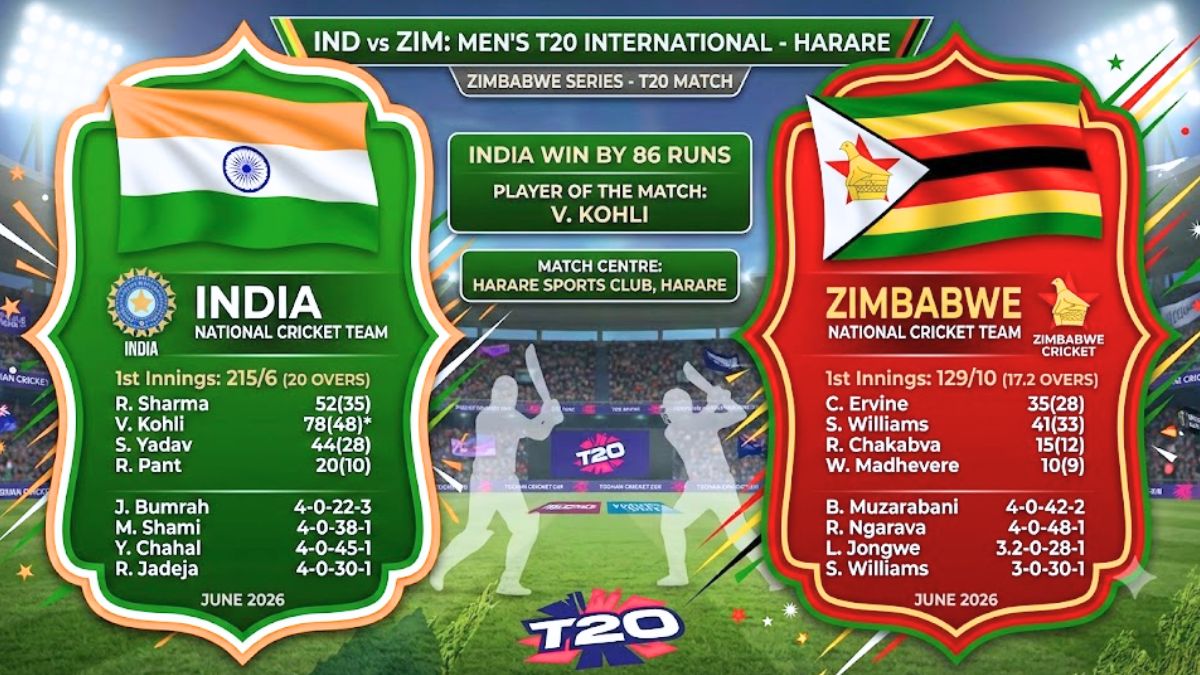
India’s Batting Masterclass: 256/4 in 20 Overs
India opened with Sanju Samson alongside Abhishek Sharma, a tactical shift that saw the team management bring in a third right-handed batter against Zimbabwe’s largely right-arm and off-spin heavy attack. Samson got off to a quick start, playing several attacking strokes before being dismissed for 24 off just 15 balls, caught at deep midwicket off Blessing Muzarabani.
Abhishek Sharma, who had endured a difficult tournament with just 15 runs in his previous four innings including three ducks, finally found his rhythm alongside Ishan Kishan. The pair added a crucial partnership that took India to 80 for 1 at the end of the powerplay, the third-highest powerplay total of the tournament. Abhishek brought up his maiden T20 World Cup half-century off 26 balls, though notably it was the second-slowest fifty of his T20I career. He eventually fell for 55 off 30 deliveries, having played a key role in setting the platform.
Ishan Kishan continued the aggressive approach, unsettling Zimbabwe’s spinners with calculated hitting before being dismissed for 38 off 24 balls. His innings included a six and a boundary off Sikandar Raza that disrupted the Zimbabwe captain’s rhythm.
Captain Suryakumar Yadav then took over, playing a typically explosive knock of 33 off just 13 balls to ensure the momentum built by the top order was not lost. His innings kept the required scoring rate above ten runs per over during the middle overs.
The real fireworks, however, came from Hardik Pandya and Tilak Varma in the closing stages. Pandya smashed an unbeaten 50 off just 23 balls, while Tilak Varma remained unbeaten on 44 off 16 deliveries, and together the duo ensured India finished with a flourish. India’s final total of 256/4 became the second-highest total in Men’s T20 World Cup history, only surpassed by their own tournament-record score set earlier in the competition.
Six different Indian batters got a chance to bat, with strike rates ranging from a brisk 158 to a scarcely believable 275. Collectively, India smashed 17 sixes in the innings, the most by the team in a single Men’s T20 World Cup innings.
Zimbabwe’s bowling effort was led by Richard Ngarava, who returned figures of 1/62, though this proved to be the most expensive bowling spell by any Zimbabwe bowler in Men’s T20 World Cup history, surpassing Sikandar Raza’s previous record. Blessing Muzarabani (1/43), Tinotenda Maposa (1/40), and Sikandar Raza (1/29) picked up the other wickets, but none could stem the flow of boundaries once India’s innings gathered pace.
Zimbabwe’s Chase: Brian Bennett Shines in a Losing Cause
Chasing a daunting target of 257, Zimbabwe never truly threatened despite a memorable individual effort from Brian Bennett. The young batter top-scored with an unbeaten 97 off 59 balls, an innings studded with eight fours and six sixes. His knock turned out to be historic for Zimbabwe cricket — it became the highest individual score by a Zimbabwean batter in Men’s T20 World Cup history, going past Sikandar Raza’s previous best of 82. Bennett also set new Zimbabwean records for most runs scored in boundaries in a single World Cup innings (68) and most sixes hit in an innings (six), both bettering marks previously held by Raza.
Bennett’s fifty in this match was also his third in Men’s T20 World Cup cricket, making him the most prolific Zimbabwean batter in terms of half-centuries at the tournament, surpassing the previous record held by former Zimbabwe captain Brendan Taylor.
Apart from Bennett, however, Zimbabwe’s batting struggled to build any real momentum. Tadiwanashe Marumani made 20 off 20 balls at the top of the order, while the rest of the lineup found scoring difficult against India’s disciplined bowling attack. Dion Myers managed just 6 off 9 balls, Sikandar Raza contributed 31 off 21 balls, and Ryan Burl fell for a golden duck. Lower-order contributions from Tony Munyonga (11 off 6) and Tashinga Musekiwa (7 off 4) offered brief flashes of resistance, but the required run rate had climbed too high by that stage for Zimbabwe to mount a serious challenge. Brad Evans was unbeaten on 1 off 1 ball when the innings closed.
Zimbabwe’s most productive stand of the chase came via a 72-run third-wicket partnership between Sikandar Raza and Brian Bennett, which became Zimbabwe’s highest third-wicket partnership in Men’s T20 World Cup history, eclipsing their own previous best of 69, also shared by the same pair.
India’s bowlers, though occasionally guilty of dropping their intensity, did enough to keep Zimbabwe well short of the target. Arshdeep Singh was the standout performer with figures of 3/24, a display that also made him India’s all-time leading wicket-taker in Men’s T20 World Cups, surpassing Jasprit Bumrah’s previous tally of 33 wickets. Varun Chakravarthy and Axar Patel each picked up 1/35, while Shivam Dube chipped in with 1/46, including the crucial wicket of Musekiwa via a sharp diving catch by wicketkeeper Sanju Samson.
Zimbabwe’s fielding continued to be a concern, as they dropped two more catches during the match, taking their tally to five dropped chances across two Super Eights fixtures, having missed only one catch through the entire first round of the tournament.
Records and Milestones from the Match
The India vs Zimbabwe clash produced several notable records:
India’s total of 256/4 stands as the second-highest innings total in Men’s T20 World Cup history.
Brian Bennett’s 97 not out is now the highest individual score by a Zimbabwean batter in the tournament’s history.
Bennett also holds the new Zimbabwean record for most runs scored in boundaries (68) and most sixes (six) in a single innings at the Men’s T20 World Cup.
The Raza-Bennett third-wicket stand of 72 runs is Zimbabwe’s best partnership for that wicket in the tournament’s history.
Richard Ngarava’s 62 runs conceded is now the most expensive spell by a Zimbabwe bowler in both Men’s T20 World Cup and overall T20I history for the country.
Arshdeep Singh became India’s leading wicket-taker in Men’s T20 World Cup history with 35 scalps.
The match aggregate of 440 runs is the highest ever recorded between India and Zimbabwe in a Men’s T20 World Cup fixture.
Post-Match Reactions
India captain Suryakumar Yadav praised his team’s collective batting effort after the match, noting that the side wanted to put their previous defeat behind them and that contributions from across the batting order were especially heartening. He did, however, acknowledge that the bowling unit needed to tighten up ahead of their upcoming clash with West Indies.
Zimbabwe captain Sikandar Raza was candid in his post-match assessment, admitting that his side’s bowling plans could have been executed better in the field, and that once India’s innings gathered momentum it became extremely difficult to pull things back. He also pointed to the inexperience of several youngsters in the squad who were playing in their first World Cup and in Indian conditions for the first time, while expressing optimism about the team’s overall performance in the tournament.
Hardik Pandya, who was named Player of the Match for his blistering unbeaten 50, expressed satisfaction with his innings and its role in propelling India to a match-winning total.
India National Cricket Team vs Zimbabwe National Cricket Team Match Scorecard 2026
What This Result Means for the Group 1 Standings
With this win, India moved level on points with West Indies in the Super Eights Group 1 table, while South Africa continued to lead the group. The result set up a virtual quarter-final between India and West Indies in their final group-stage match at Eden Gardens, with the winner advancing to the semi-finals of the tournament. For Zimbabwe, the defeat effectively ended their historic run in the competition, though they were set to play out their final Super Eights fixture against South Africa.
Road to the Match: Context Behind the Contest
This was Zimbabwe’s seventh appearance at a Men’s T20 World Cup, but remarkably, it marked the first time in the nation’s history that they had progressed as far as the Super Eights stage. Their run to this point had included several upset results that turned heads across the tournament, but a defeat to West Indies in their opening Super Eights fixture meant they entered the India game already under pressure to avoid an early exit.
For India, the equation was equally stark. A second consecutive Super Eights loss would have all but ended their hopes of defending the title they won at the previous edition. Team combinations were reportedly under close discussion in the lead-up to the match, with batting coach Sitanshu Kotak confirming that changes were being considered. The final XI saw Sanju Samson brought in at the top of the order in place of a struggling opener, while Axar Patel returned to the side ahead of Washington Sundar, a move designed to counter Zimbabwe’s largely right-handed batting lineup.
Historically, India held a strong head-to-head record against Zimbabwe in T20 internationals, having won 10 of the 13 previous meetings between the two sides. The last bilateral series between the teams, played in Zimbabwe in mid-2024, had also ended in India’s favour despite Zimbabwe claiming the opening match of that series. This Chennai clash was the 14th T20I meeting overall between the two nations, and it continued India’s historical dominance in the format against Zimbabwe.
Key Talking Points From the Chennai Night
Several storylines emerged from this contest that are likely to shape the narrative heading into the business end of the tournament. Abhishek Sharma’s return to form will be a significant relief for the Indian team management, given his struggles earlier in the competition. His maiden World Cup half-century, even if it came at a relatively slower strike rate than his usual standards, showed his ability to anchor an innings when required.
On the bowling front, questions remain over India’s death-overs execution, an area both Suryakumar Yadav and former India captain Anil Kumble flagged as needing improvement. Kumble specifically noted that on flatter surfaces like the one at Chepauk, India might benefit from fielding an extra specialist batter rather than an additional frontline bowler, a tactical debate that is likely to continue as the tournament progresses.
For Zimbabwe, the tournament ends on a high note in terms of individual performances, even though the team’s campaign in the Super Eights did not yield the results they would have hoped for. Brian Bennett’s emergence as a genuine match-winning talent, and the collective fighting spirit shown throughout their historic run to the Super Eights, are likely to be remembered as one of the standout stories of the 2026 edition of the tournament.
Conclusion
India’s clinical performance against Zimbabwe in Chennai was exactly the response captain Suryakumar Yadav’s side needed after a disappointing loss to South Africa. Abhishek Sharma’s return to form, Hardik Pandya’s explosive finish, and Arshdeep Singh’s record-breaking bowling spell all combined to deliver a comprehensive 72-run win. While Brian Bennett’s record-breaking century-near knock will be remembered as one of the individual highlights of Zimbabwe’s maiden Super Eights campaign, it wasn’t enough to prevent India from keeping their title defence alive heading into a decisive showdown with West Indies.